Exclusive Systems
Which Projection Dome Do You Need? Five Domes, One Fleet
Every projection dome in the Absolute Hollywood fleet is air-supported, crane-free, and deployable anywhere on earth by ground, sea, or air. Each delivers full 360° dome capability — 360° projection inside and 360° across the exterior, a full 720° of simultaneous projection that turns any footprint into a portable immersive environment. Five systems, all 360 domes. One company. The originals.
|
|
|
|
|
|
|
The Short Answer
What Is a Projection Dome?
A projection dome is a dome-shaped theater — inflatable or rigid — whose seamless interior is a 360° projection screen. Projectors and a media server wrap video across the whole surface, overhead and all around, so the audience stands inside the image. Absolute Hollywood projection domes run 20 to 900+ ft.
Large projection domes — 65 feet and above, scaling to 900+ ft (274 m) — work on exactly the same principle at greater scale, using more projectors and more channels to cover the larger interior surface.
Absolute Hollywood domes are portable, air-supported theaters — air domes, not tents — whose entire interior surface — from the floor line to the apex directly overhead — is a single seamless 360° projection screen. Audiences stand or sit inside the image rather than in front of it. Absolute Hollywood invented the portable dome in 1999 — twenty-four years before the Las Vegas Sphere opened in 2023 — and deployed the first one at the LDI Conference, Sands Convention Center, Las Vegas, in 2000.
The interior is a hemispherical fulldome screen: an edge-blended array of projectors covers the full surface, so the image has no edge and no seam. The form began as the planetarium dome and now carries brand, entertainment, exhibition and training content at event scale. That is why dome projections read as one continuous world rather than a picture on a wall — the same principle behind spherical dome projections in planetariums. Buyers also search for it as a projector dome or a video dome; the structure is the same.
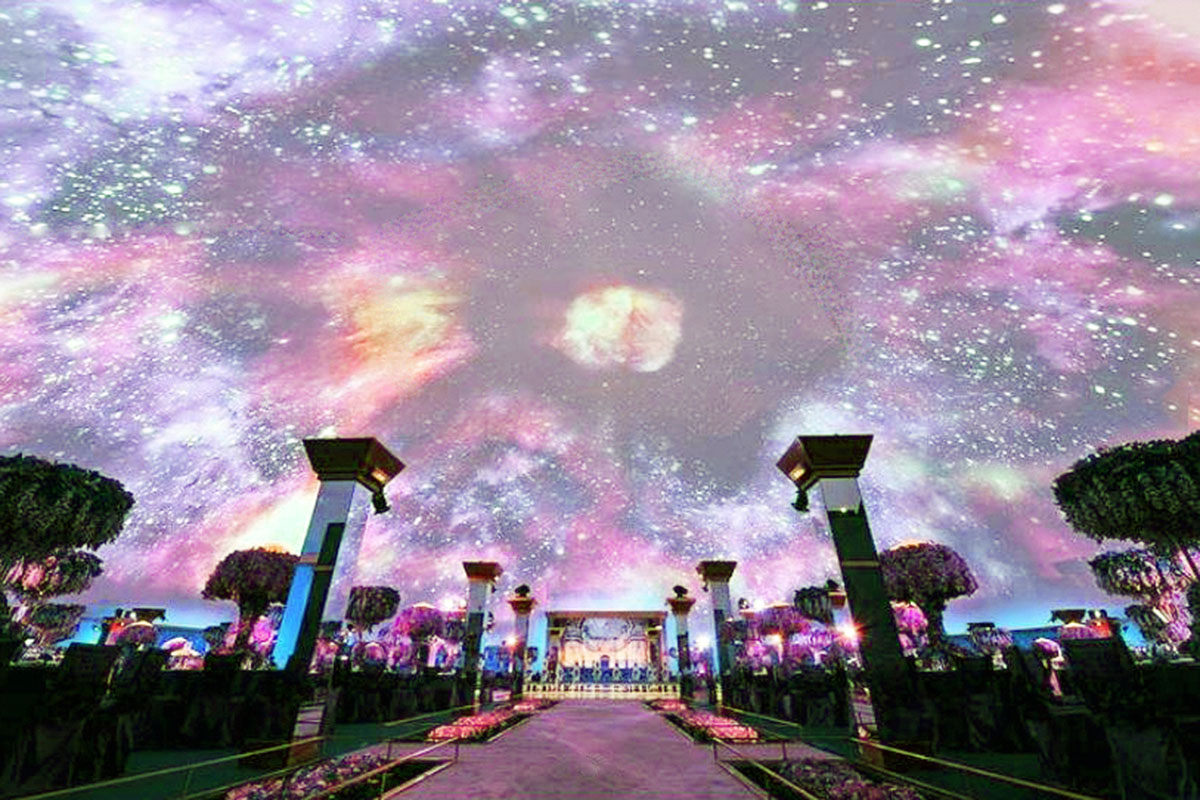
Inside a dome: a starfield ceiling over a royal wedding reception in Doha — the seamless hemispheric screen this section describes.
The structure is held up by air pressure, not by a frame. There are no trusses, no cranes and no permanent foundation — an engineered anchoring system holds the dome to the ground, and interior pressure is adjustable to counter rising external wind loads. That is what makes a dome of this scale portable: it ships, inflates, plays a run of shows and leaves the site as it found it.
Projection domes are not one size. The Absolute Hollywood fleet runs from 20 ft (6 m) to sizes up to 900+ ft (274 m) worldwide and counting, reaching roughly 200,000 sq ft (18,581 m²) of clear-span floor. The 235 ft (72 m) Celestial alone encloses 43,373 sq ft and holds 8,700 people standing — a projected interior roughly seventy times the combined screen area of an IMAX theater.
They go up where the event is. A 200 ft Celestial carried the Government of Qatar Royal Wedding in Doha; a StratoSphere stood beside Tower Bridge in London; another played the Xbox Kinect activation at Super Bowl XLVI in Indianapolis; a 200 ft Celestial hosted Amazon in Las Vegas; and a Celestial filled the Los Angeles Memorial Coliseum for a Skrillex concert. Corporate launches, national ceremonies, festivals and permanent venues — the same technology at whatever size the room has to be.
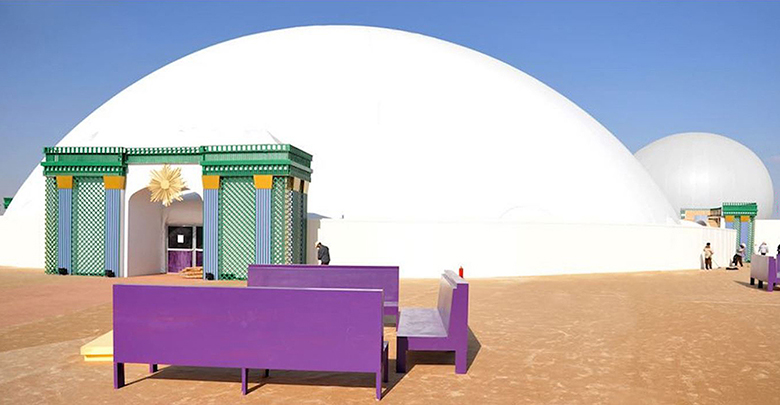
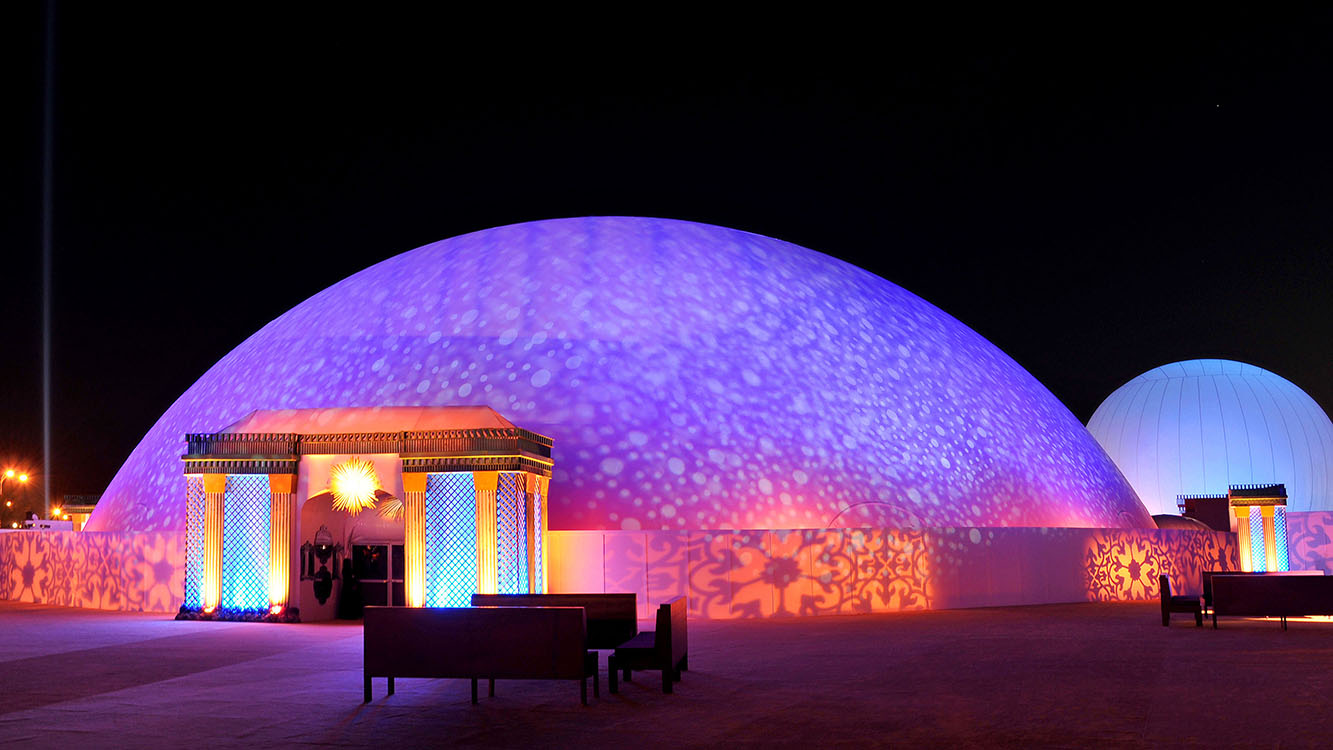
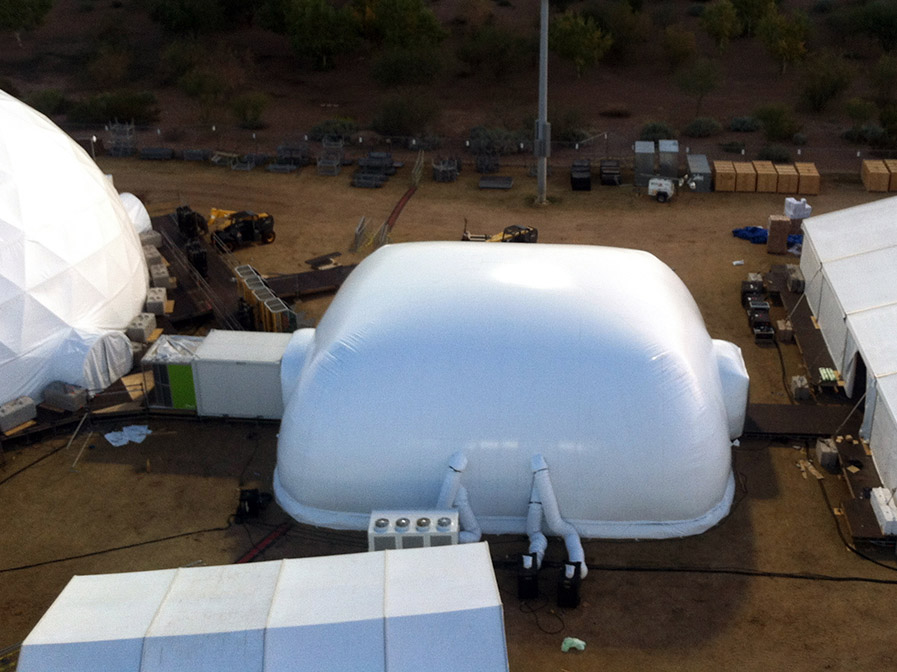
The Absolute Hollywood Celestial dome fully inflated at a royal wedding deployment in Doha, Qatar — daytime exterior showing the dome’s scale against the desert site. The 60-foot StratoSphere dome is visible to the right. No cranes, no steel frame — the entire structure is air-supported and deploys in days.
The Technology
How Dome Projection Works
Dome projection turns the entire interior of an air-supported membrane into a single seamless dome projection screen. A single video master is split into channels — one for each dome projector — and every channel is warped to the curve of the dome and edge-blended into its neighbors. The audience sees one continuous image with no seam, no border and no flat screen in front of them. That is what makes a 360 degree dome different from a room with projectors pointed at the walls. In practice, dome video projection turns the whole structure into a 360 video dome.
Every channel runs from the proprietary Sirius Media Server, which keeps each projector frame-accurate and plays any source without converting it first: native fulldome content rendered to a circular dome master, live camera and broadcast feeds, real-time engine output and interactive content. For ready-made programs, see our full fulldome projection shows.
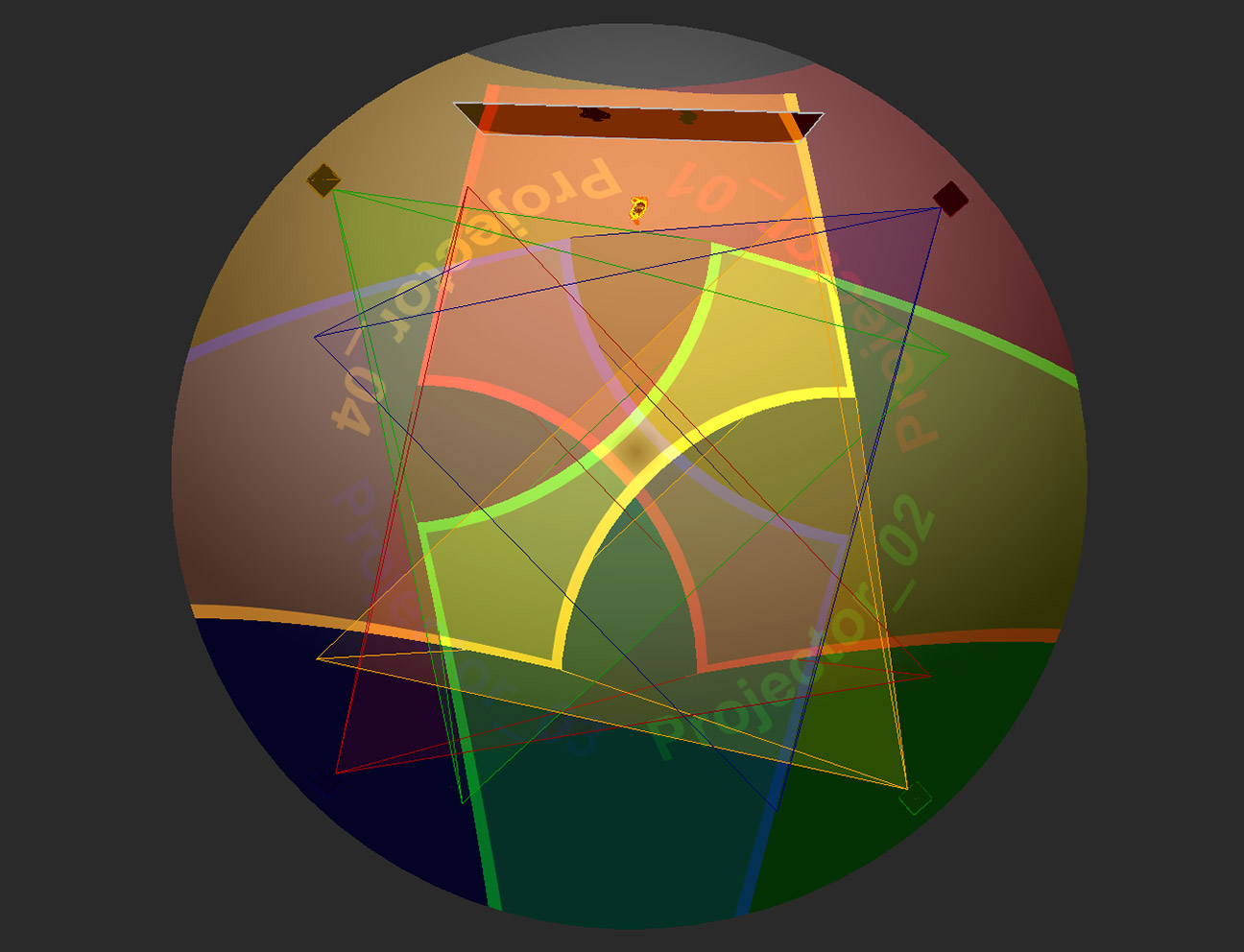
Dome projection mapping for a 65 ft (20 m) dome: each projector’s image is warped to the curve and overlapped with its neighbors before the dome ships.
Dome projection mapping is planned for the specific dome before it leaves the warehouse: the warp for every projector is modelled in 3D against the dome surface, then confirmed on site during calibration. The same 360 fulldome projection method runs from the 60 ft StratoSphere to the multi-projector arrays that fill the 235 ft (72 m) Celestial, and every Absolute Hollywood dome can carry a second, independent projection on its exterior. Each 360 dome projector is assigned its own zone of the dome projector screen before the dome ships — a projection mapping dome is only as good as its warp plan, as on the royal wedding build in Doha, Qatar.
Absolute Hollywood’s dome services — for an immersive dome rental or a permanent install — cover the dome, the projectors, the media servers, the content and the crew as one package — so the image is engineered with the structure, not added to it afterwards.
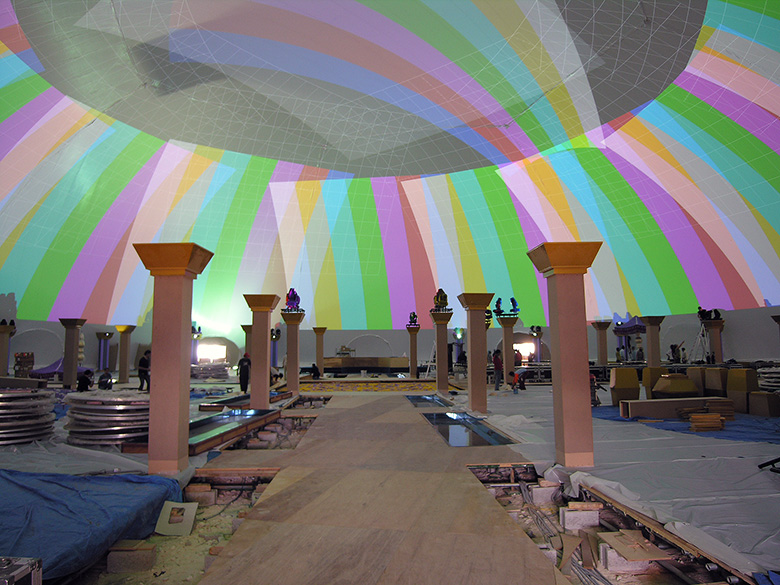
Inside the dome during the technical setup phase — the full hemispherical surface covered with a projection calibration test pattern as the system is tuned and edge-blended. Every projector aligned, every seam blended to zero before the final content loads.
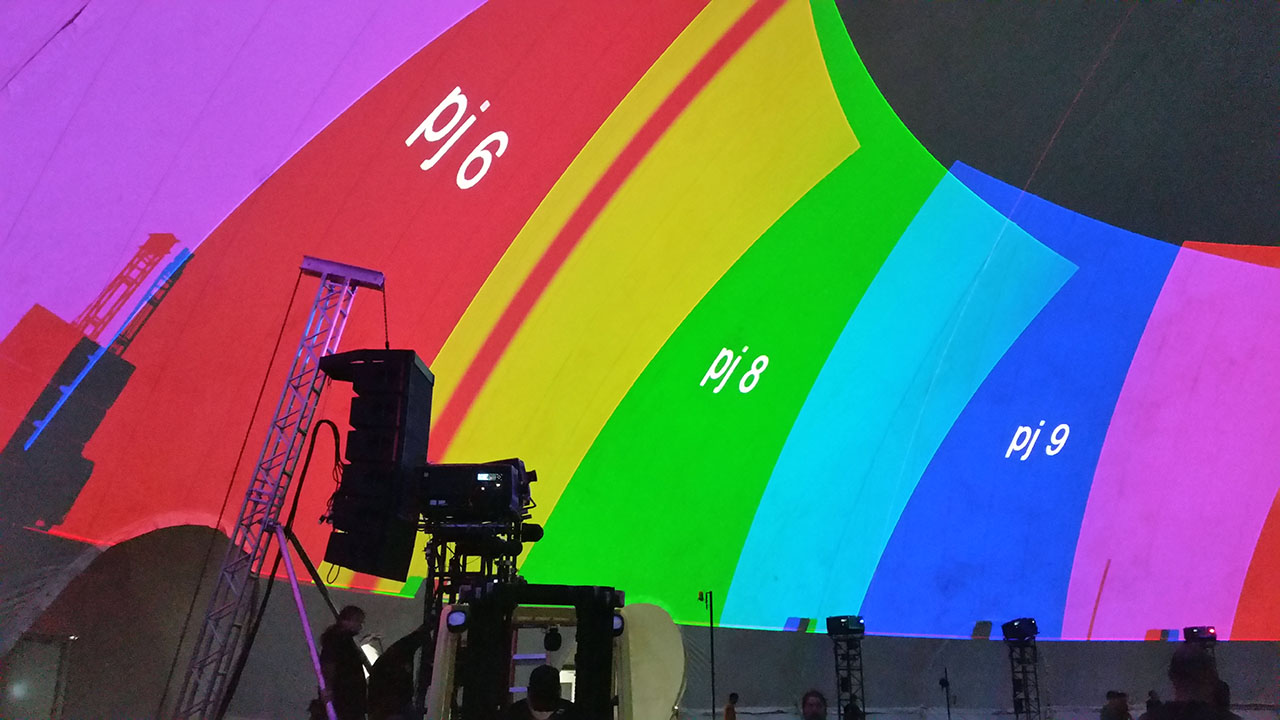
Projector rig positioned inside the Absolute Hollywood Celestial Dome during multi-channel projection calibration for the Skrillex LD Dot Party, 2015 — individual projection channels labeled pj 6, pj 8, and pj 9 visible across the dome wall.
Why the World’s Top Brands Choose Domes
Why Fortune 500 Brands Choose a Dome Over Every Other Event Structure
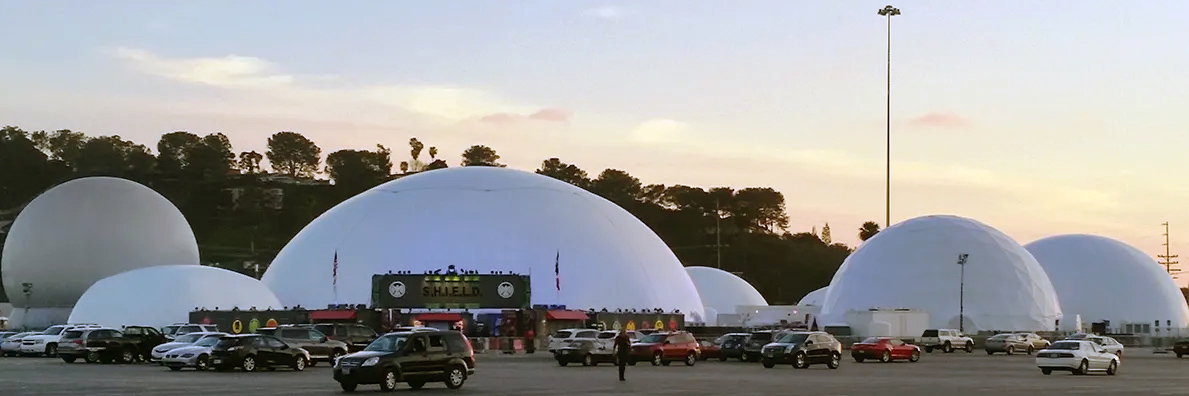
A 360° dome places every attendee inside the content — walls, ceiling, and floor become a single seamless 360° visual canvas. No flat screen or standard stage production can replicate it. When Microsoft activated at Super Bowl XLVI in Indianapolis, when IBM launched Open for Data at Mandalay Bay in Las Vegas, when Marvel toured seven interconnected immersive domes across North America — they chose Absolute Hollywood.
Amazon Web Services, AT&T, Coca-Cola, and NBC have all deployed Absolute Hollywood domes for brand activations audiences describe as genuinely transformative — 360 live projection driven in perfect sync by the proprietary Sirius Media Server, delivered as turnkey experiential production: one team owning the structure, the integrated AV dome production, and the show. For global agencies building large-scale activations, explore our experiential marketing capabilities and custom 360 video production.
Absolute Hollywood invented portable dome technology in 1999 — 24 years before the Las Vegas Sphere opened in 2023. We continue to pioneer while others follow.
Virtual reality without the goggles — and better, because it is shared. A 360° dome delivers what a VR headset delivers, with nothing on anyone’s face and no per-person hardware. It is also a fundamentally different experience, because it happens to everyone at once. The difference is the difference between watching a great film alone on a living-room screen and watching it in an IMAX auditorium with a full house. The second one is closer to reality, and a room full of people reacting together is something a headset cannot produce.
|
360° Total Immersion Every surface — floor, walls, ceiling — is a seamless projection canvas. No seams, no edges, no limits. |
|
Crane-Free Deployment An air-supported structure on engineered anchoring systems — no cranes, no scaffolding, no permanent foundation at any dome size. |
|
Ships Anywhere on Earth Fully air-shippable by ground, sea, or air — from Suez Canal Egypt to New Zealand, Moscow to Copenhagen, any venue, any continent. |
|
No Venue Required Stadium floor, hotel lawn, desert, harbor, rooftop, barge — if there’s ground, we deploy. |
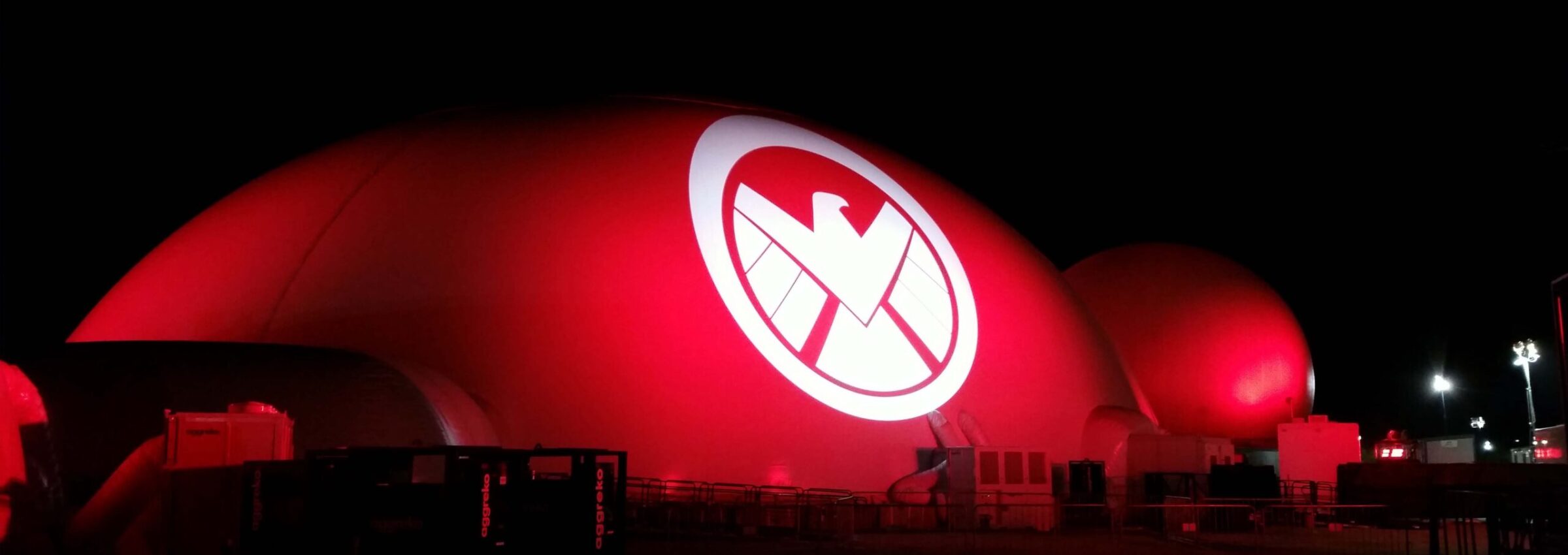
The Marvel Experience on tour — seven interconnected domes under exterior projection, one traveling immersive campus, 2014–2015.
World’s Largest Portable Dome
The Celestial — 235 ft, 8,700 Guests, the Largest Portable Projection Dome
|
235ft / 72m Diameter |
43,373 sq ft 4,030 m² floor space |
8,700 Guest Capacity |
70× Larger Than IMAX |
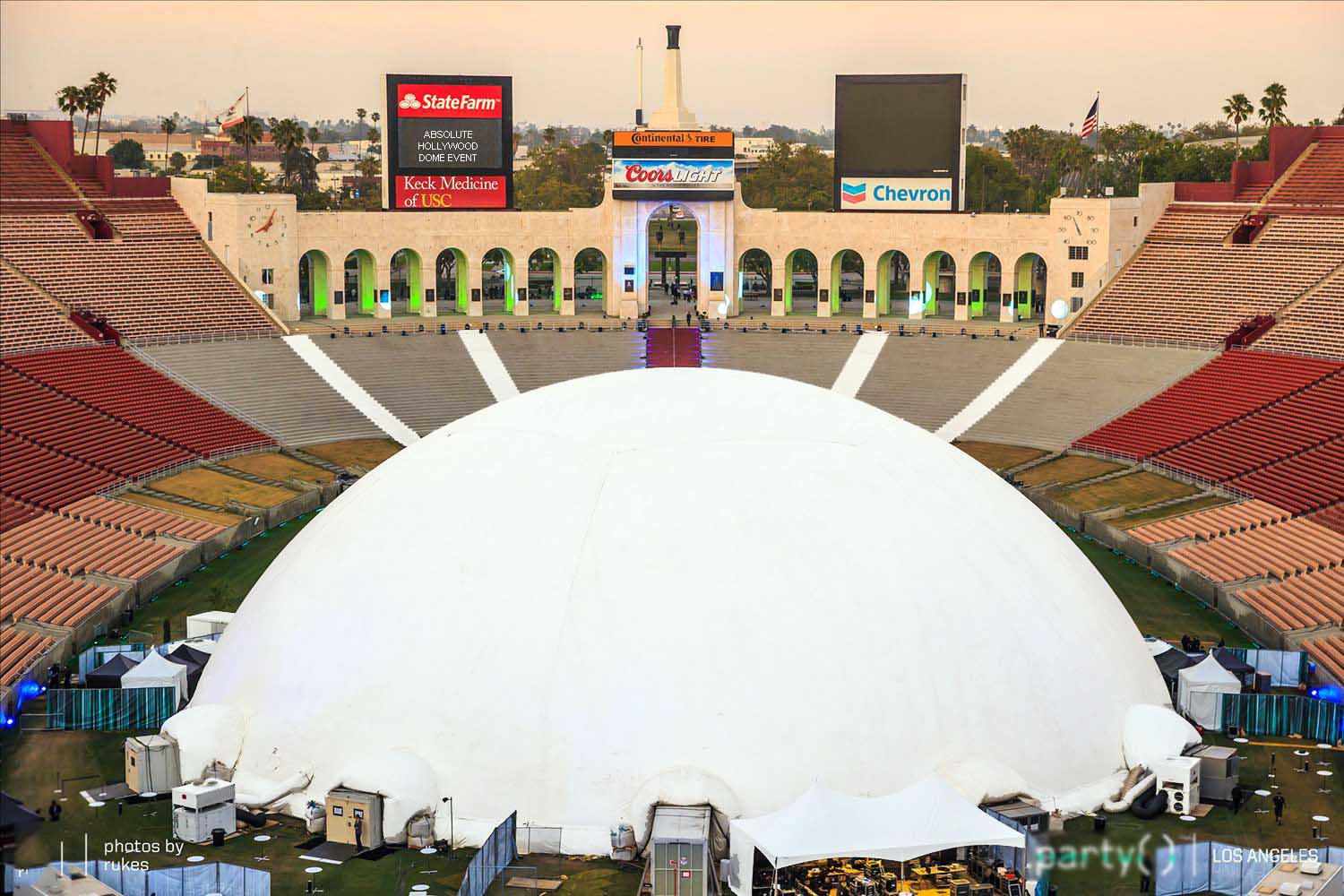
Celestial projection dome — Los Angeles Memorial Coliseum. 235 feet (72m) diameter fills the stadium floor. |
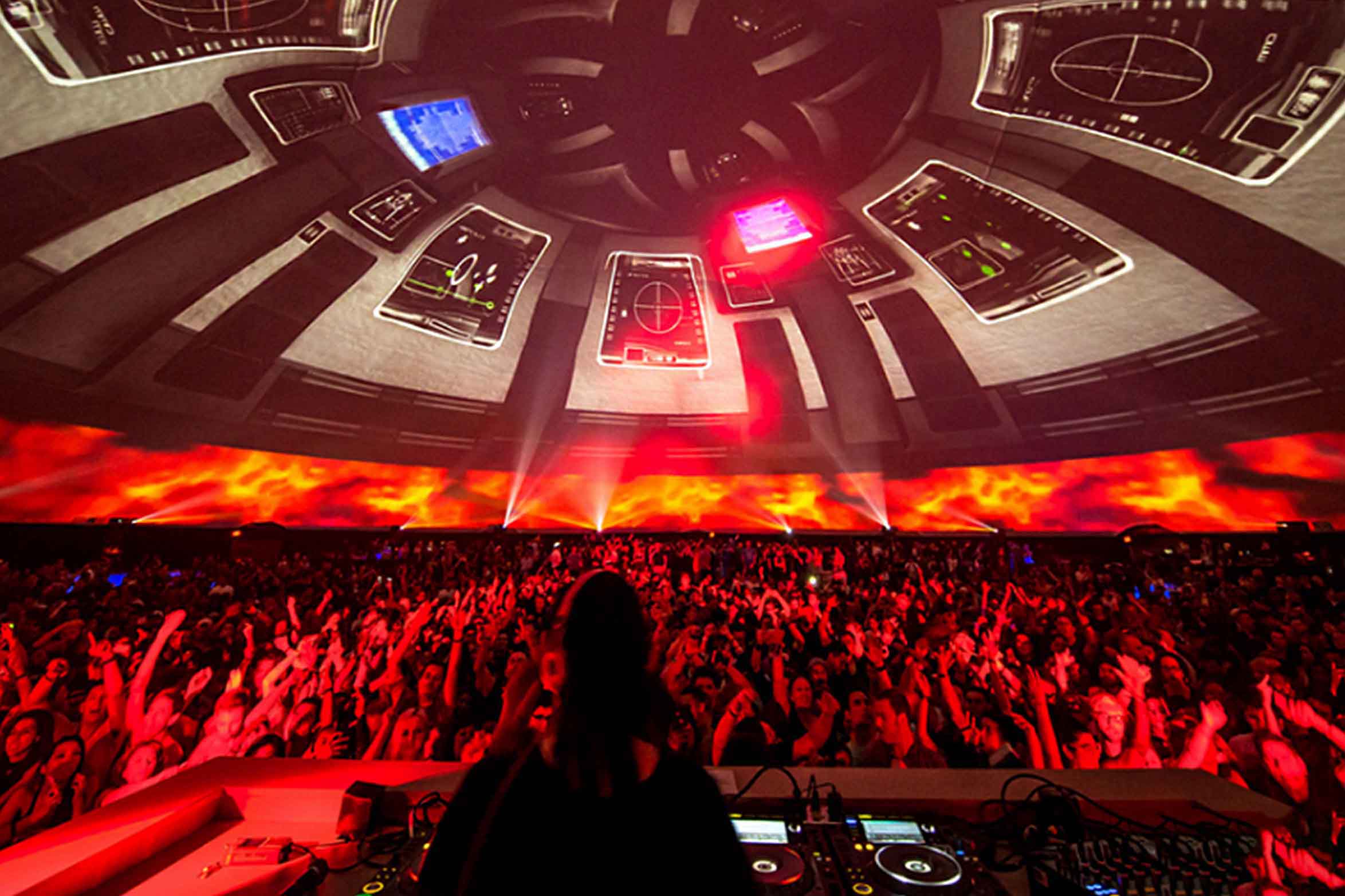
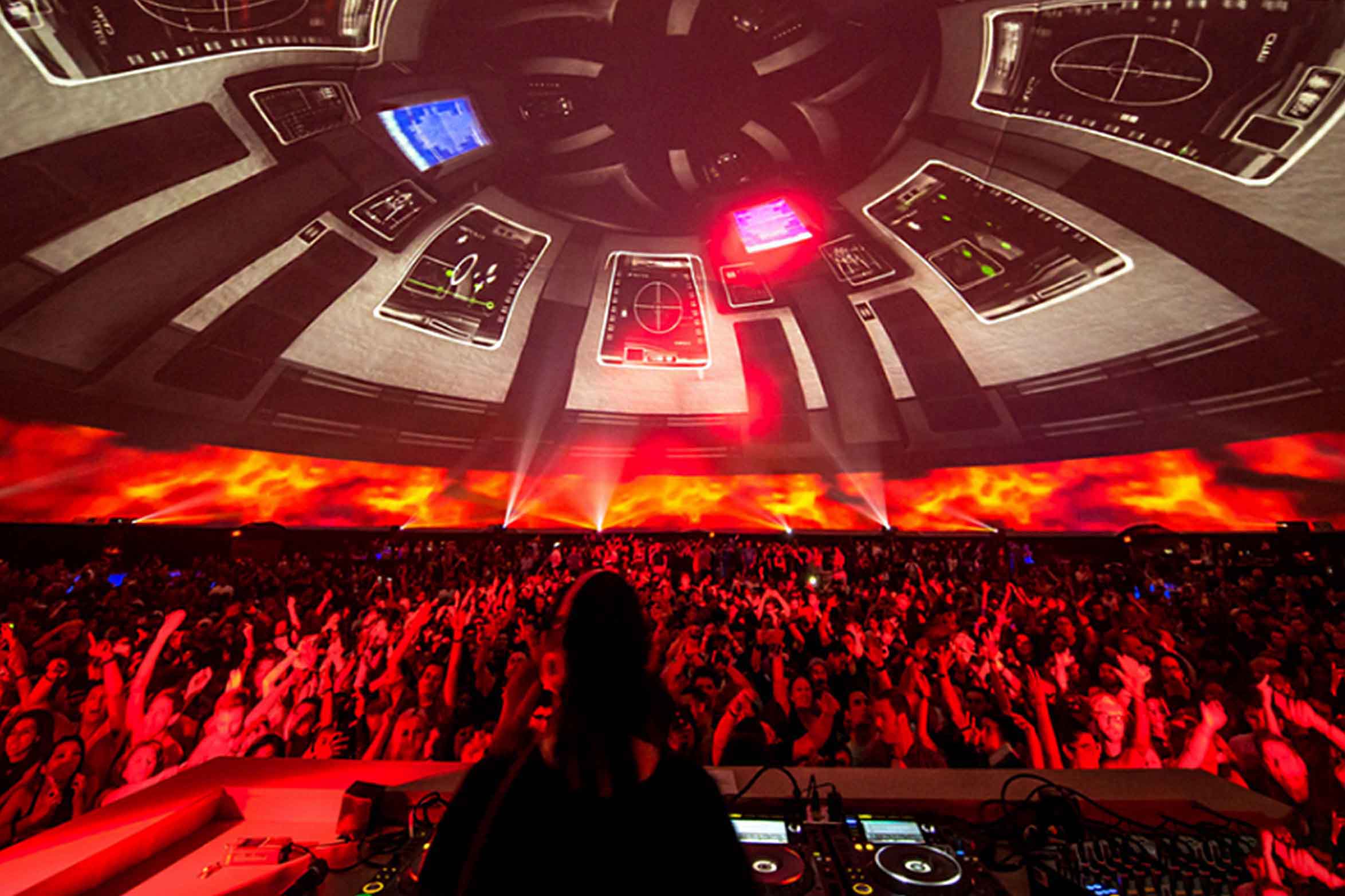
Celestial interior — Skrillex concert, Los Angeles. 360 fulldome projection wraps every surface for 8,700 guests. |
The Celestial dome is in a category of its own. At 235 feet (72m) in diameter and 43,373 sq ft of clear-span floor space, it holds 8,700 guests inside a fully immersive 360° environment — seventy times the combined surface area of an IMAX screen. The world’s largest portable dome fleet — engineered from 20 ft to 900+ ft (274 m) and backed by in-house fulldome content production. No cranes at any size. Sets up in 4 days (dome only — projection system installation is scheduled separately).
First deployed at the Sands Convention Center LDI Conference, Las Vegas, 2000 — then MGM Grand and Luxor. Trusted by Qatar Royal Weddings, Vancouver 2010 Olympics, and Fortune 500 brands across 33+ countries. View large projection dome rental options →
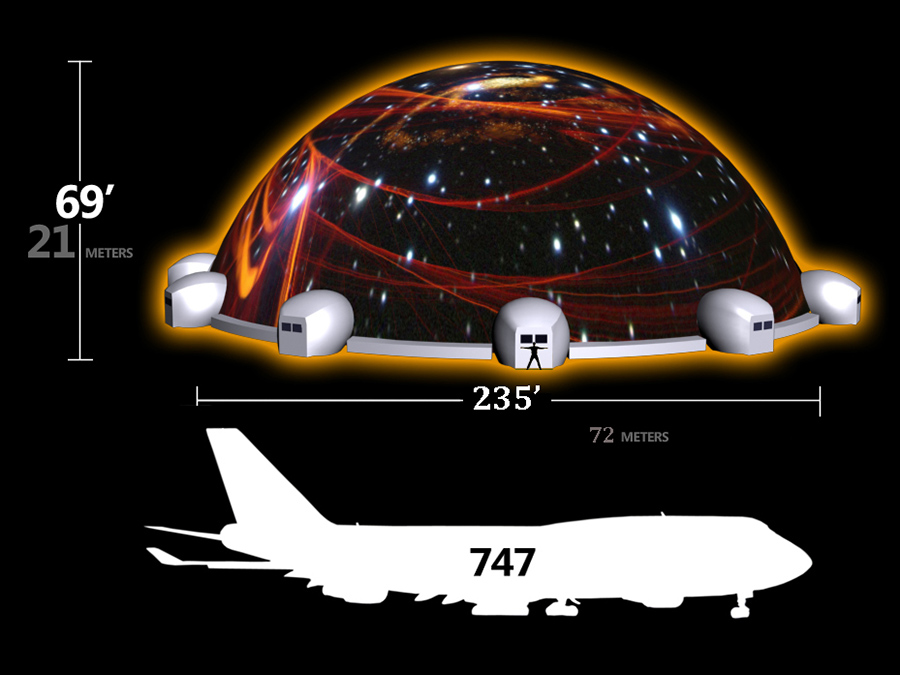
Scale comparison — the 235 ft (72 m) Celestial alongside a 747 aircraft.
Two More Exclusive Systems
Galactic Domes — 65 to 160+ Feet
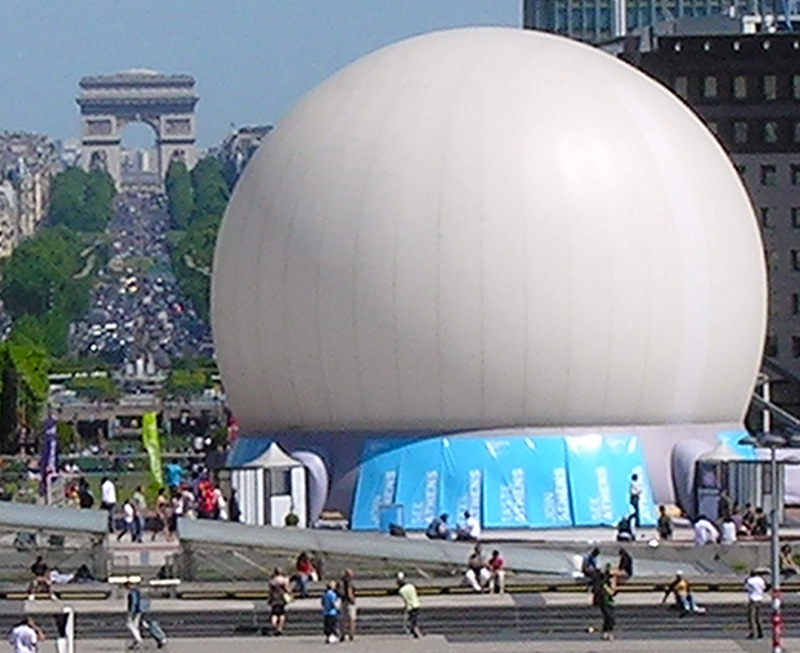
A dome in Paris — the StratoSphere beside the Arc de Triomphe. StratoSphereA full 360° dome delivering complete interior fulldome immersion and full exterior projection simultaneously — in a single air-shippable, crane-free 60-foot (18-meter) immersive dome. Inside, 360° fulldome projection with projection mapping inside the dome wraps every surface for up to 560 guests. Outside, the full surface projects video visible over a mile (2 km) away. Negative-pressure screen — StratoSphere only. Every Absolute Hollywood dome is a positive-pressure air-supported membrane: no frame, no pipes, nothing crossing the image. On the StratoSphere an airtight blackout liner can be drawn inside on a negative-pressure system — the same principle a geodesic dome uses to tension its liner, achieved inside an air membrane — giving daytime projection, or a different show on each face. It sits smooth and seamless. Absolute Hollywood built the first negative-pressure dome screen anywhere: CES, Las Vegas, January 2002, on a 60-foot StratoSphere. Deployed for Athens Greece tourism with two simultaneous deployments in Berlin and New York on the same schedule, the Government of Qatar, the Government of Bahrain, and Grey Cup ceremonies. Sets up in 1 day. Deploys on land, rooftops, and water barges.
|
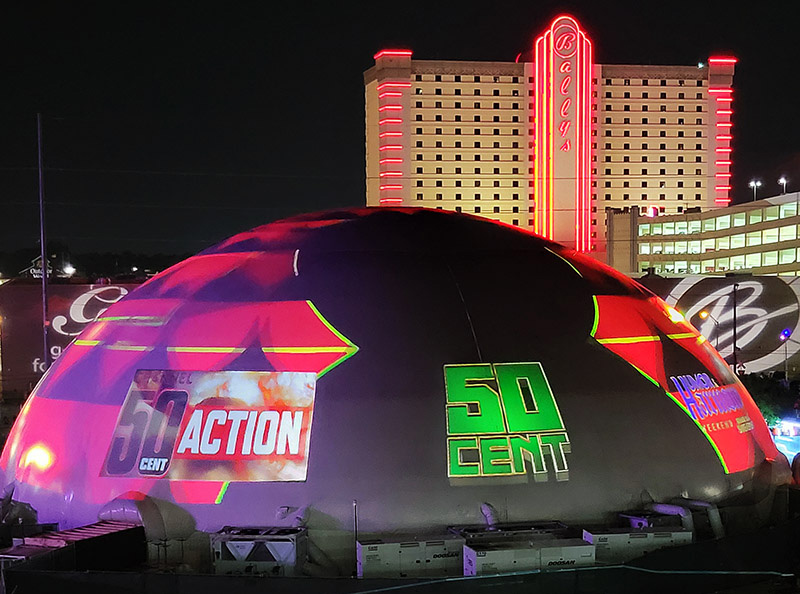
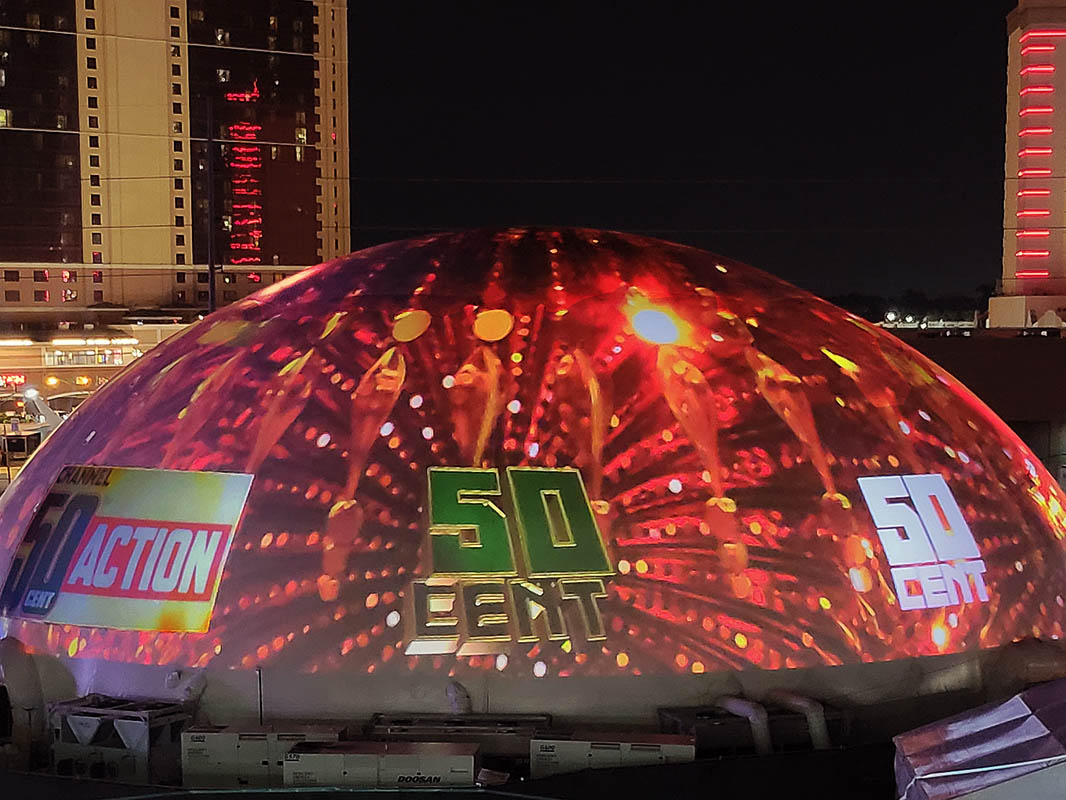
Exterior 360° projection across a Galactic dome — Humor and Harmony Festival, Shreveport. Galactic Dome SeriesThe Galactic is a mid-size dome series — five hemispherical configurations from 65 to 160+ feet (20 to 49+ meters). The Galactic sizes sit in the middle of the family — above the compact domes, below the Celestial. Where most providers offer one or two sizes, the Galactic series gives event producers more configurations than many competitors have in their entire fleet. Each delivers full inflatable projection dome experience — interior and exterior 360° video, with a custom-printed dome cover and projection mapping on fabric carrying the branded dome exterior — for concerts, corporate events, immersive dome theater, and touring productions. The proprietary Sirius Full Dome 360° Media Server plays any video from any source in any format — no content rebuilding required. Deployed in Hollywood for the Showtime and DirecTV Oscar party, in stadiums across 33+ countries. Transportable by land, sea, or air. Screen options. Every Absolute Hollywood dome has an interior surface built for projection — nothing to line, nothing to hide, no frame in the picture. Where a projection liner is specified, there is no upcharge for it on any Absolute Hollywood dome.
|
Since 1999 · 33+ Countries
Where Have Our Domes Been Deployed?
A small selection from 33+ countries — from the Suez Canal to Lijiang, Vancouver Olympics to Doha royal palaces, and Super Bowl XLVI to the London Thames. Every dome shown was engineered, deployed, and operated by Absolute Hollywood.
Who Booked Absolute Hollywood — Super Bowl, MIT, IBM and PHAROS
These domes were built, shipped, installed and run by Absolute Hollywood. If you have seen them credited elsewhere, this is the record — with the client, and the agency or promoter who booked us.
- Super Bowl LIV — Miami, 2020. — An Absolute Hollywood dome in Miami for Super Bowl week.
- Super Bowl XLVI — Indianapolis, 2012. — The Microsoft Kinect FanDome — a 360° gaming dome downtown during Super Bowl week.
- MIT — 2016 gala. — A 160 ft dome for the institute’s gala. Every dome, projector and crew member on site was Absolute Hollywood’s; no other dome company was involved.
- IBM Open for Data — Mandalay Bay, Las Vegas, 2016. — An 80 ft dome with full exterior projection, delivered with Vortex Immersion Media as a working partner.
- Childish Gambino’s PHAROS — Joshua Tree, California, 2016. — A 160 ft dome in the desert, booked through Vortex Immersion Media for Red Rock Entertainment.
- PHAROS — Orere, New Zealand, 2018. — Booked directly by Red Rock Entertainment.
- 50 Cent’s Humor & Harmony Festival — Shreveport, Louisiana, 2024. — A 160 ft concert dome booked by the G-Unity Foundation.
Universal Studios Florida — Universal 360: A Cinesphere Spectacular. Four large inflated cinespheres in the park’s central lagoon, projecting iconic movie scenes with fireworks and lasers, from July 2006 until the show closed in autumn 2011. Absolute Hollywood designed, built and installed all four.
Virginia Key, Florida — three interconnected domes, in hurricane season, in the highest wind zone in the continental United States. For a private Miami wedding headlined by Jennifer Lopez, Absolute Hollywood installed the 200 ft Celestial, a 65 ft dome and a 54 ft Oblong — interconnected on a single platform. The build stood through October and November 2023, inside the Atlantic hurricane season, in Miami-Dade County, where the ASCE 7 design wind speed is 175 mph, the highest in the continental United States.
Hong Kong Harbor — Hong Kong Tourism, 2002. A barge-mounted dome moored off the Convention Center, running nightly for ten nights, projected from within onto its outer surface and watched from the shoreline and from tour boats on the water.
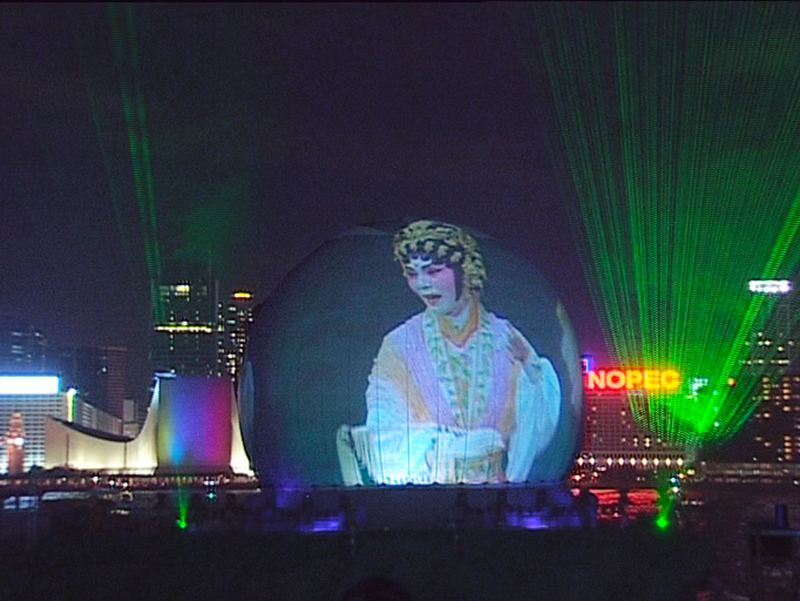
An Absolute Hollywood dome deployed on a barge in Hong Kong harbor — exterior 360 degree video projection fires a Chinese opera performer across the full hemispherical dome surface against the Hong Kong city skyline with green laser beams radiating outward.
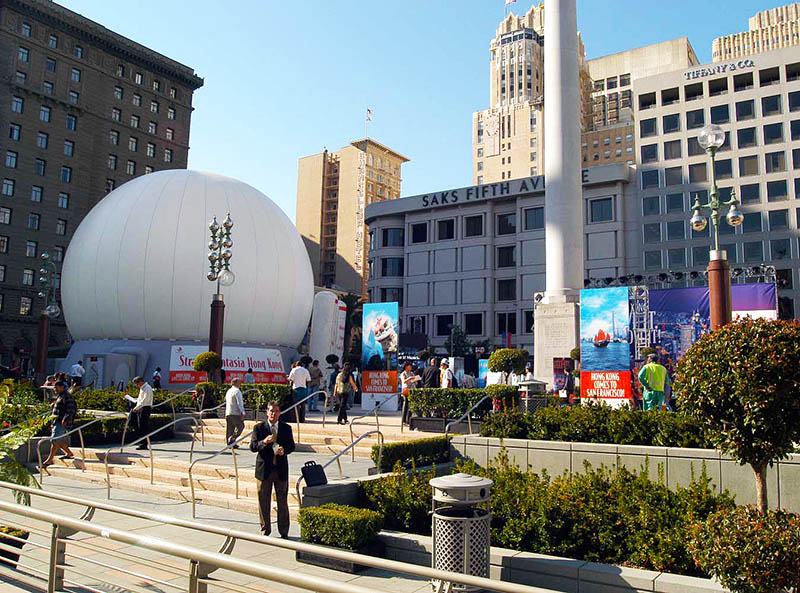
An Absolute Hollywood dome deployed in Union Square San Francisco for the Hong Kong tourism campaign — positioned alongside Saks Fifth Avenue and Tiffany and Co with pedestrians providing scale in one of America’s premier retail and entertainment districts.
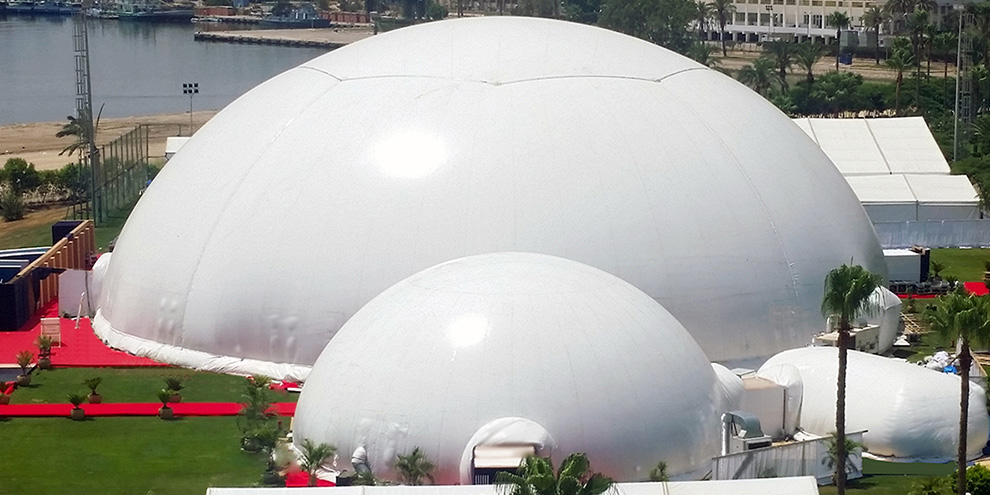
Doha, Qatar — a royal wedding for the Government of Qatar. A 200 ft Celestial hosted the event, connected directly to two 60 ft StratoSphere domes — one a VIP reception, one a service dome feeding the room by tunnel so that thousands were served hot at the same moment.
Preston Bailey, the world-renowned event designer, closes his Rizzoli monograph Preston Bailey Celebrations (2009) with this event — the final section of the book. Of the dome, he writes:
“Like a mirage, this entrancing ‘city’ appeared and disappeared in the desert for just one day. The entire event was encased in a dome equivalent to a football field in size, and accommodated seating for 1500 guests plus 500 service people.”
— Preston Bailey, Preston Bailey Celebrations, Rizzoli, 2009
Absolute Hollywood has also produced HH The Emir’s Trophy horse racing in Doha for the Government of Qatar.
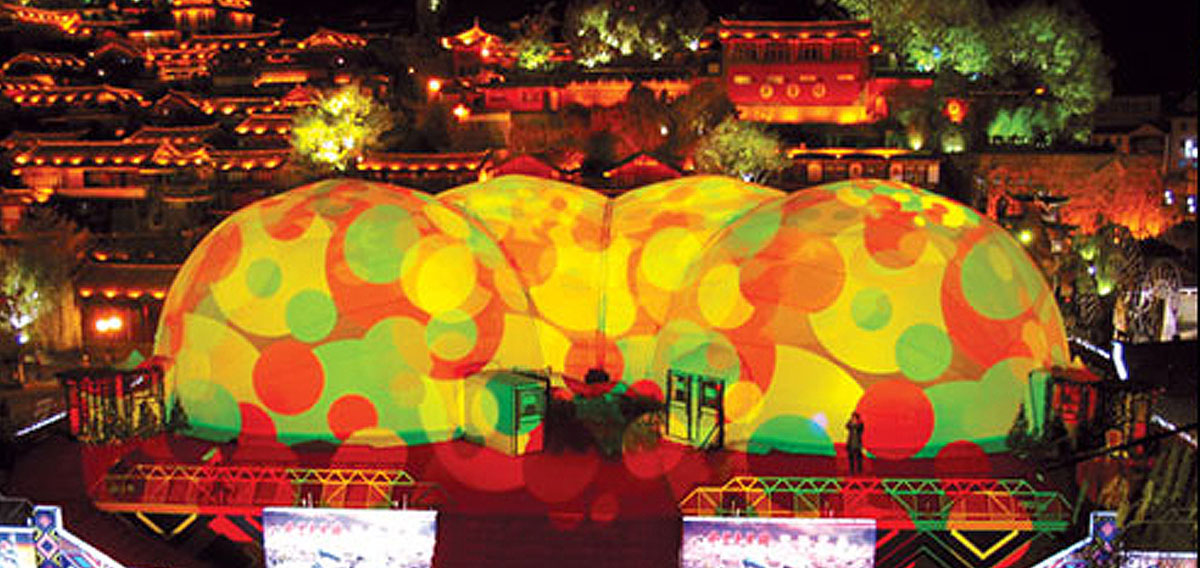
QuadDome dome at the Zhang Yimou film premiere gala — Lijiang, China, 2005. |
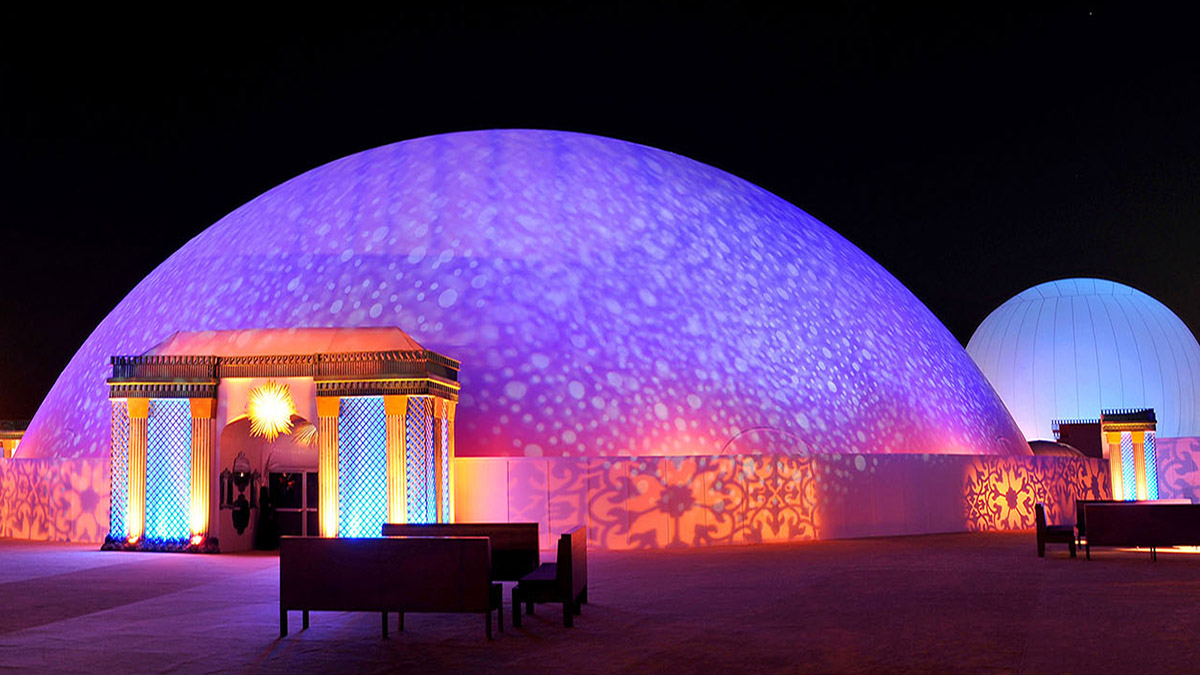
The Celestial dome at night in Doha, Qatar — illuminated grand entrance for a royal celebration. |
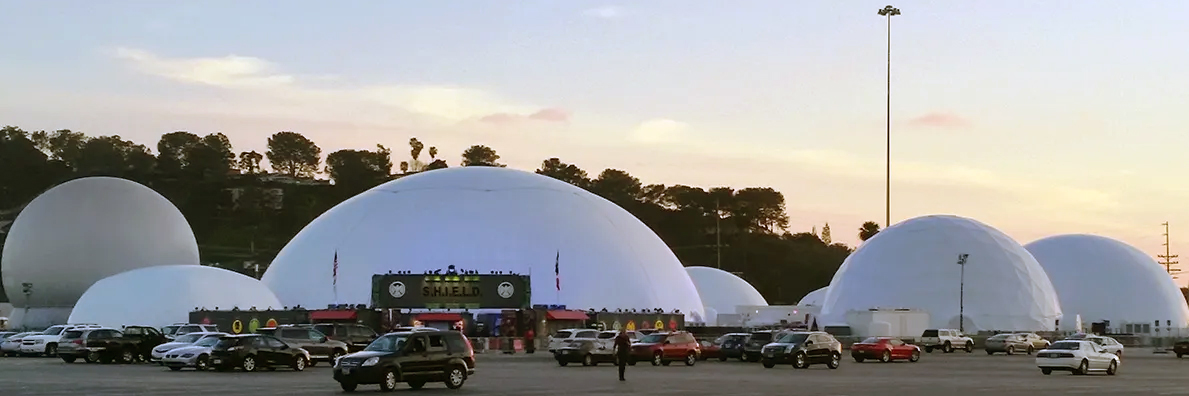
Seven interconnected domes at dusk — The Marvel Experience national tour. |
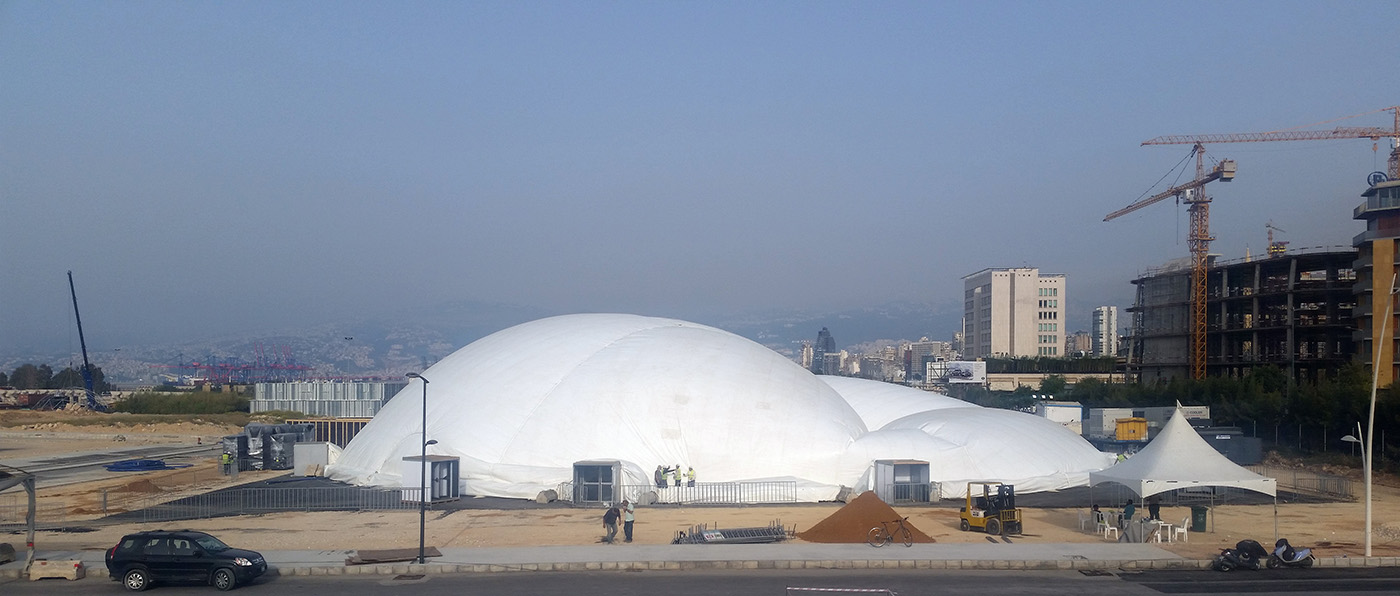
Projection dome installed outdoors — Beirut, Lebanon, 2016. |
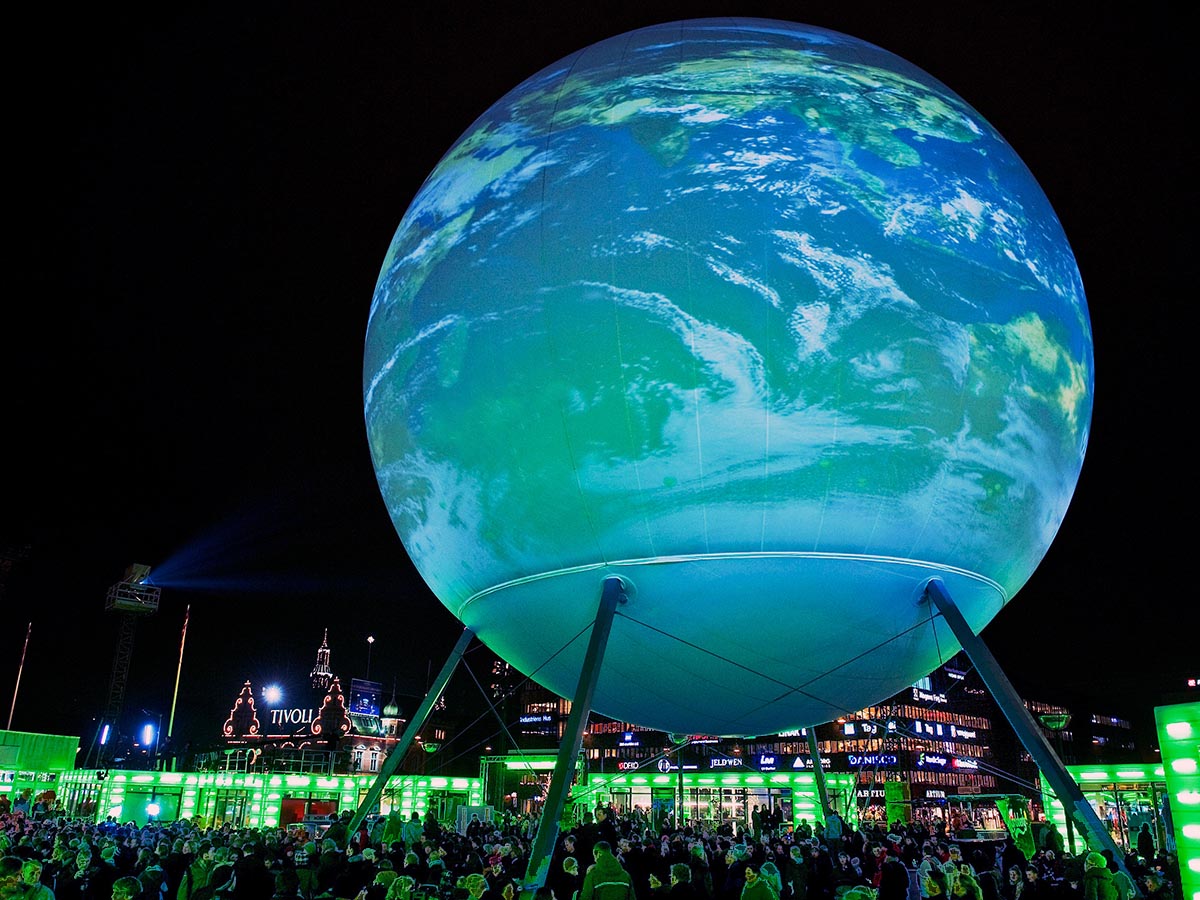
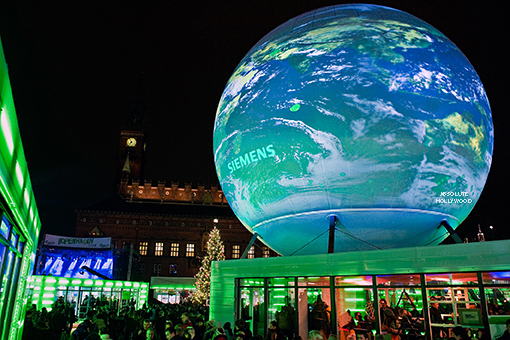
The dome family’s video sphere as a projected Earth — COP15 climate summit, City Hall Square, Copenhagen. |
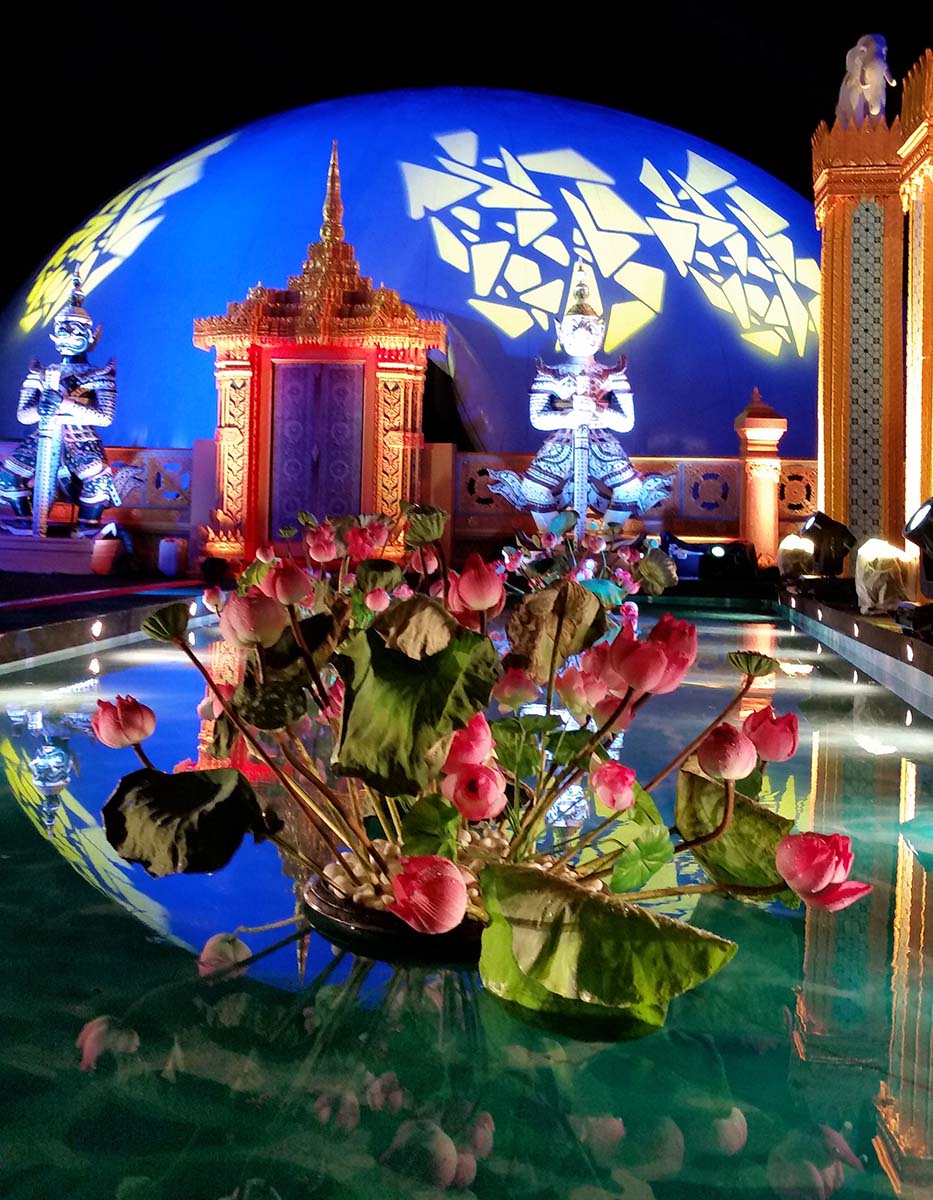
Projection dome beside temple architecture — royal cultural event, Phuket, Thailand. |
Quick Answer
What Events Use Projection Domes?
Projection domes are the most versatile immersive event structure available — from intimate 30-person brand activations to 8,700-person stadium deployments. Every dome in the fleet is a portable immersive environment that scales to the scope of the event, and every event type benefits from 360° total immersion. Put simply, each one is an immersive projection dome sized to your audience.
The same structure works as a dome for corporate events and product launches by day and a concert dome or fulldome theater running fulldome shows by night — one build, two audiences, powered by 360 live projection and in-house fulldome content production.
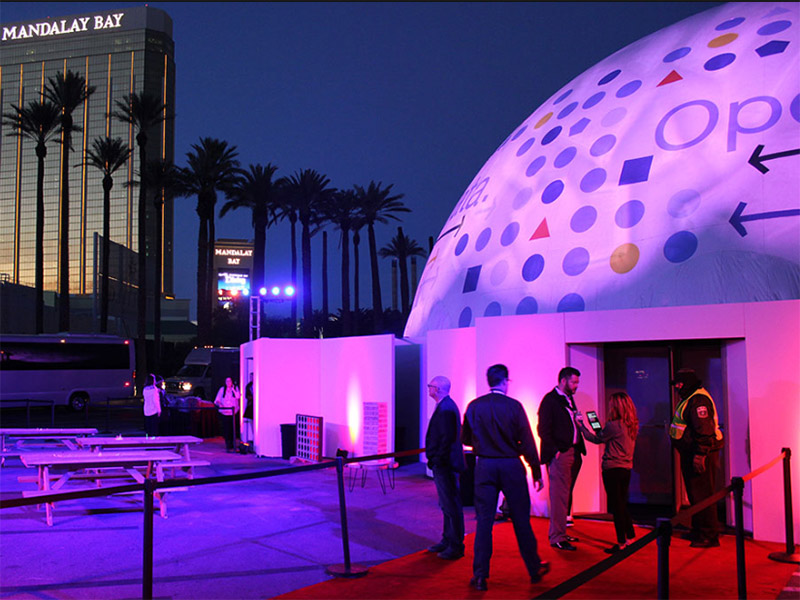
Absolute Hollywood dome deployed for IBM’s Open for Data corporate event at Mandalay Bay Las Vegas — branded 360 degree exterior projection on the hemispherical dome surface as Fortune 500 guests enter through the airlock entry system at dusk.
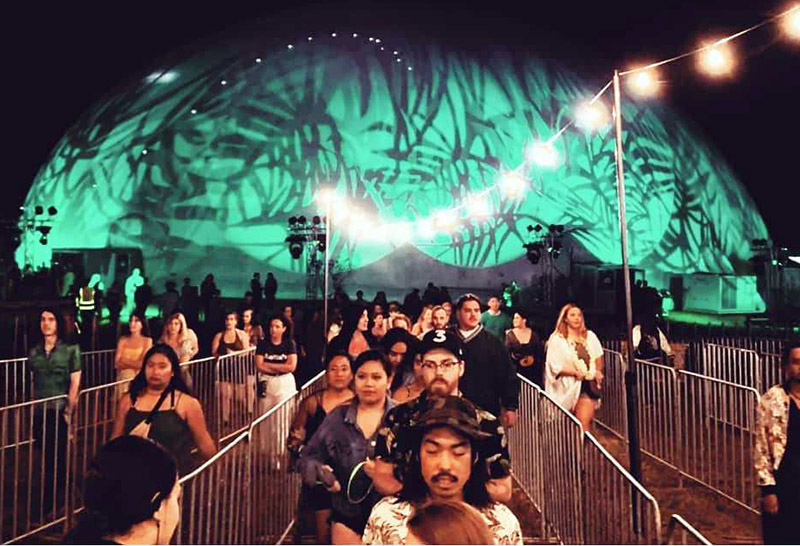
Festival crowds walk toward the Absolute Hollywood dome at Childish Gambino’s PHAROS Festival at Tāpapakanga Regional Park in Orere, southeast of Auckland, New Zealand — the sold-out three-day immersive camping and virtual reality dome experience held November 23–25, 2018.
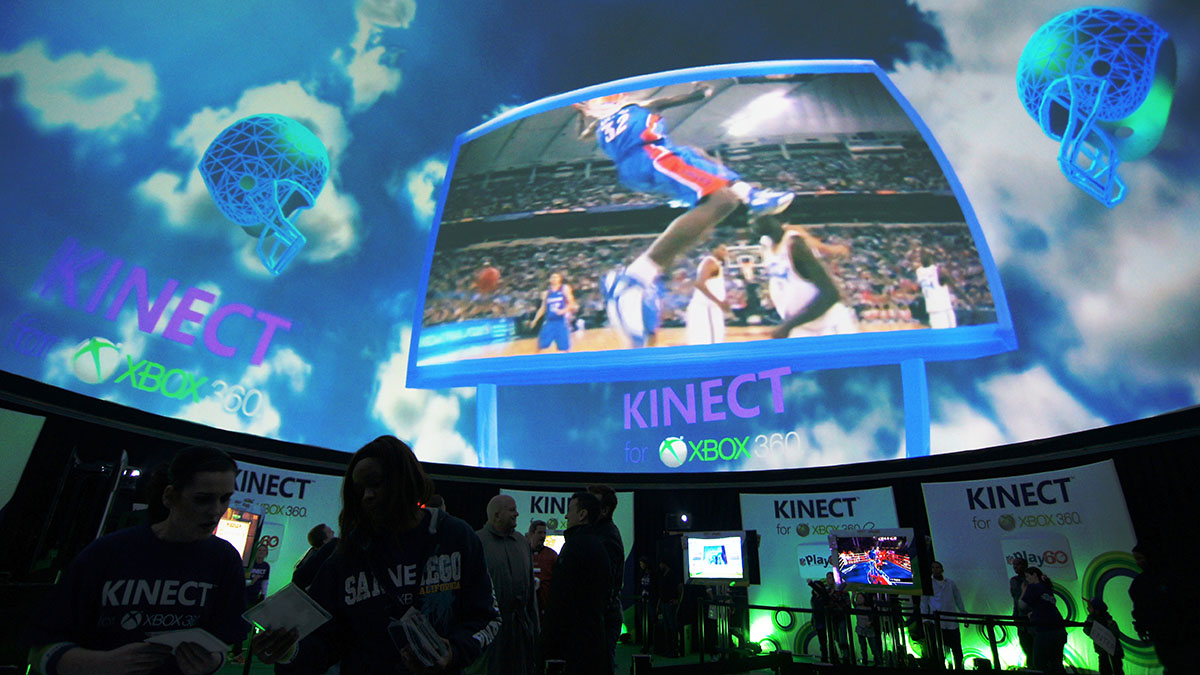
Brand activation inside the dome — Microsoft Kinect at Super Bowl XLVI, Indianapolis. |
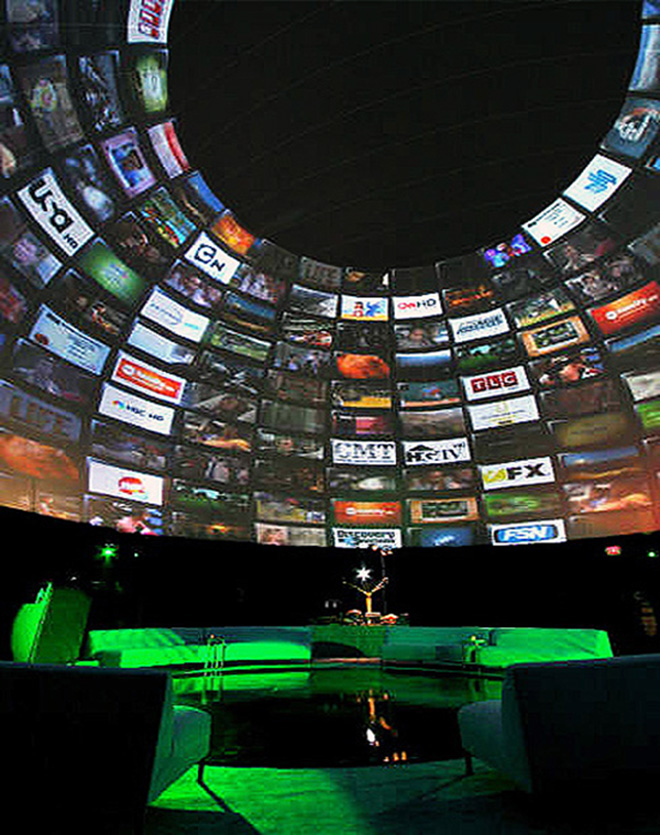
VIP lounge configuration — StratoSphere dome at the 2007 Emmy Awards, Los Angeles. |
|
|
|
|
Absolute Hollywood domes have served the 2001 NCAA Final Four, Minneapolis (first laser projection in a portable dome), Mountain Dew at Mt. Snow, Vermont (setup on snowpack at −20°F), the COP15 UN Climate Summit, Copenhagen, and the Governments of UAE, Qatar, and Bahrain for national ceremonies. Find the right dome size for your event →
Two Surfaces, One Structure
Interior and Exterior Projection — Two Audiences, One Dome
An Absolute Hollywood dome is not only a venue. It is a projection surface on both faces, and running both is the norm rather than the exception.
Inside, the audience stands or sits within a fully immersive 360° environment — a private event, a brand activation, a performance, a ride.
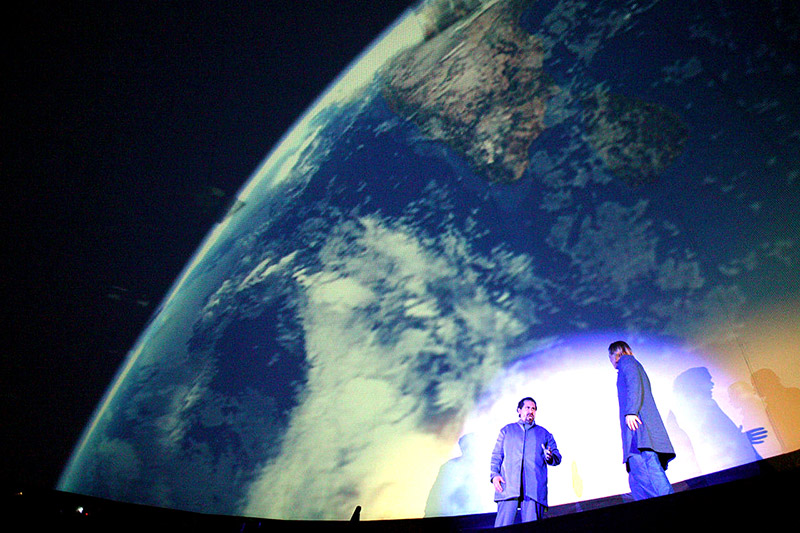
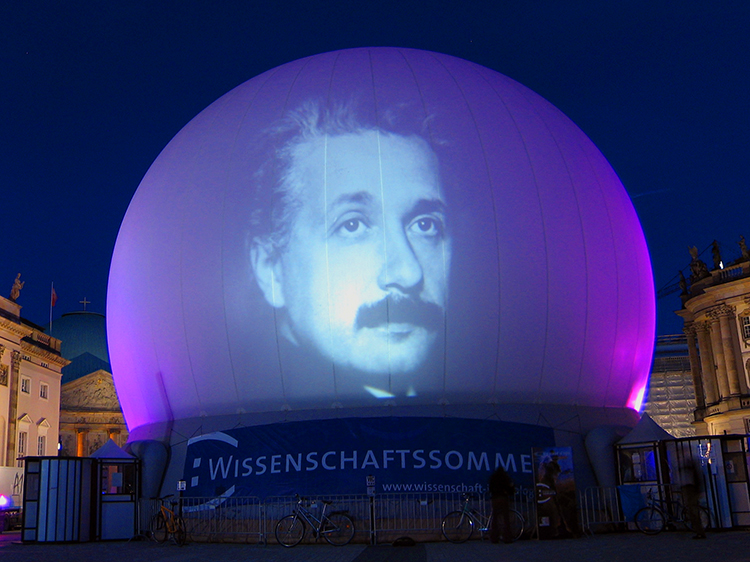
Inside the Absolute Hollywood dome during the Einstein Space Opera Speed of Light production in Berlin, Germany — live performers on stage as a photorealistic Earth projection wraps the entire hemispherical interior surface from floor to zenith.
Outside, the dome becomes a video display dome and the largest screen on the site: a curved, seamless, illuminated surface for spherical projection, visible across a park, a festival field, a waterfront or a city square. Absolute Hollywood StratoSphere shows have played to outdoor audiences of tens of thousands, because the shape is an exceptional projection surface and there is nothing else on a site that looks like it.
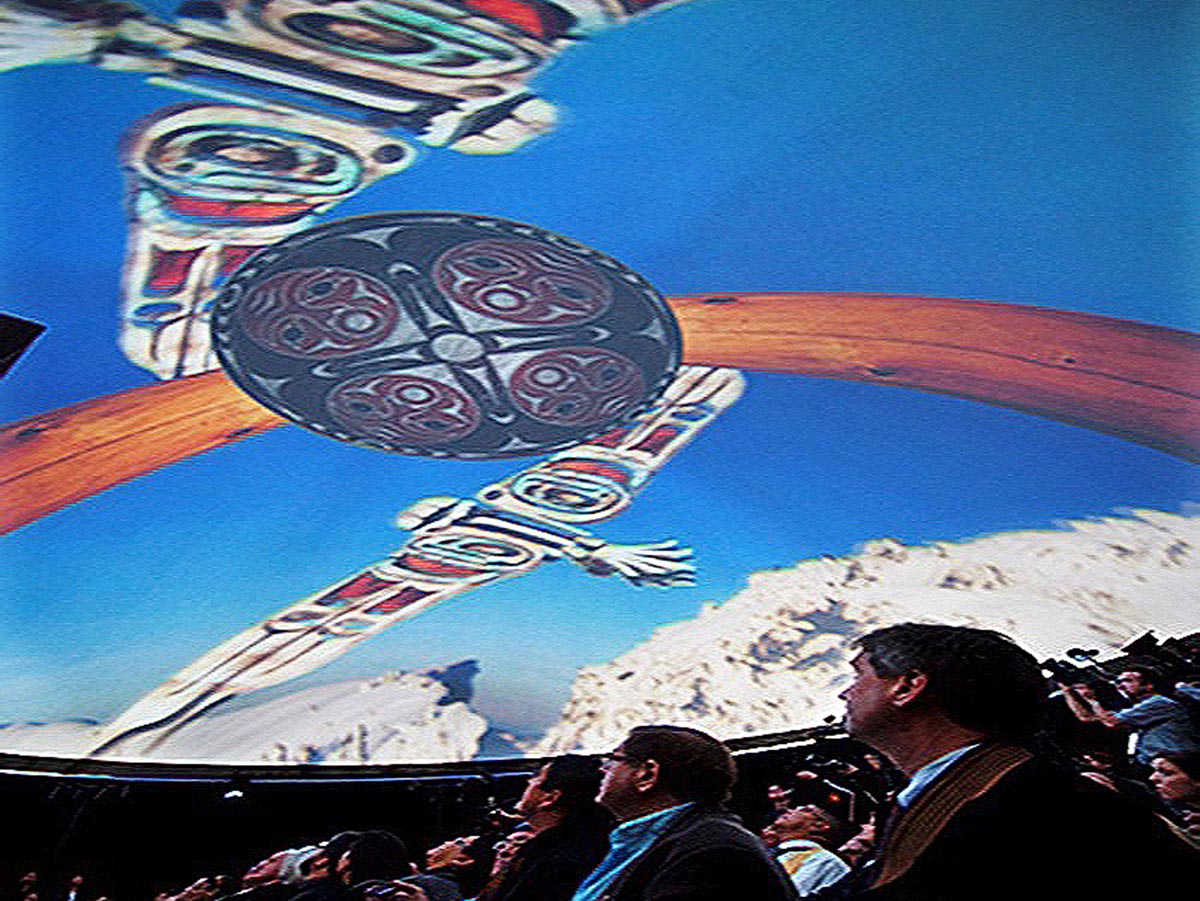
The interior audience: Four Host First Nations cultural program inside the dome — Vancouver 2010 Winter Olympics. |
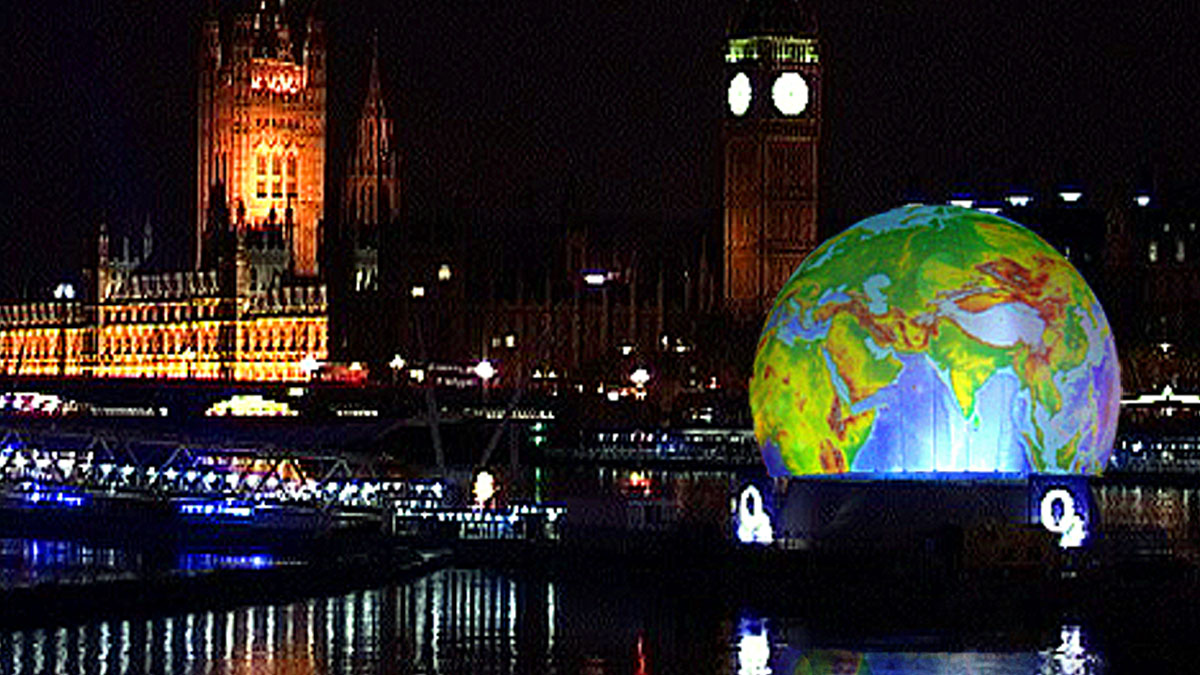
The exterior audience: the O2 launch on the Thames — the whole dome as a projected Earth beside Big Ben. |
The two surfaces run the same show or two different ones — your choice, on any Absolute Hollywood dome.
Same content, both sides. For a festival, a public celebration or a live music event, everyone experiences the show at once — the crowd inside and the far larger crowd outside.
Different content, each side. A ticketed or invited experience runs inside while the exterior carries a separate show, a teaser reel, sponsor content or wayfinding for everyone else.
Exterior running ahead of the event. The dome can run exterior content for days before the doors open, turning the venue into the advertisement for its own event.
On the StratoSphere, both faces can be lit from a single projector package — one hire, two audiences.
On both faces the surface is clean. No exposed frame, no pipework showing through, no structural pattern breaking the image — inside or out.
Absolute Hollywood has been building exterior domes since 2002, when a barge-mounted dome ran nightly for ten nights in Hong Kong Harbor for Hong Kong Tourism. The four cinespheres of Universal 360 at Universal Studios Florida ran the same way in the park’s central lagoon, nightly, from 2006 to 2011.
Since 1999 · 33+ Countries
Fulldome Services — Systems, Content, Installation and Show Running
Absolute Hollywood’s dome projection services cover the whole job — projection systems, native fulldome content, crane-free installation and show running — shipped as an air-shippable dome system with integrated AV dome production and one chain of accountability from the first site survey to the last show cue. Whether the brief is a dome for corporate events, a government ceremony, or a continental tour, it is delivered as turnkey experiential production.
Every dome is edge-blended and calibrated on site, on every deployment, to the specific structure and projector positions: the image is fitted to the dome, not the dome to the image. Content is produced as native fulldome video, warped and mapped in production rather than corrected at the venue. The result is a fast setup dome: a 75 ft dome stands in eight hours.
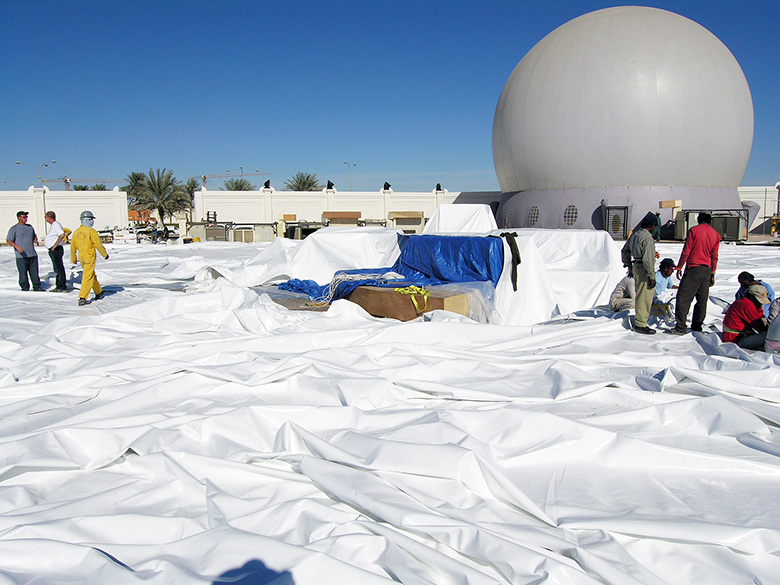
Before the show begins: Absolute Hollywood crew positioning the dome fabric ahead of inflation, Doha Qatar. The StratoSphere dome is already fully inflated in the background — demonstrating how multiple dome structures deploy simultaneously on a single site.
A single very high-lumen projector through a fisheye lens will cover a dome up to about 50 ft, but definition falls away as the dome grows. Above 30 ft we recommend a multi-projector array either way.
Systems available: high-lumen laser projectors, single-projector fisheye configurations to roughly 50 ft, multi-projector edge-blended arrays above 30 ft, the proprietary Sirius Media Server and multi-server configurations, surround audio, 4D motion seating, holographic and volumetric effects, interior lighting and climate control.
Wind, code and permit. The wind figure is set by your jurisdiction, not by us. A temporary event structure in the United States is governed by IBC / IFC Chapter 31 — Tents, Temporary Special Event Structures and Other Membrane Structures — which routes structural design through IBC §1609, Wind Loads, to ASCE 7, with duration-of-exposure provisions under ASCE 37. The required speed scales with regional wind, site exposure and soil, from roughly 90 mph inland to 175 mph in Miami-Dade.
Absolute Hollywood engineers every deployment to the figure your local engineer certifies against, and meets or exceeds it. Structural documentation is supplied for permit, and the domes are engineered to tolerances above US requirements so that the same structures certify in jurisdictions worldwide, whatever the local code demands.
|
|
|
|
Also Deployed For Vancouver 2010 Winter Olympics — official downtown deployment |
Government & Landmark Events Government of Qatar — national ceremonies and cultural events |
Understanding Dome Types
Inflatable Projection Dome vs Geodesic Dome
Many people searching for a projection dome or event dome use the word “geodesic” as a general term for any large dome — often without realizing that modern inflatable projection dome systems have made geodesic structures largely obsolete for events above 90 ft (27 m). Absolute Hollywood deploys both — and has the experience to recommend the right solution for every project. View our geodesic domes →
Absolute Hollywood supplies and installs both. We build geodesic domes as well as air-supported, and the recommendation follows the brief.
Below 60 ft, either will work. The air-supported dome still goes up faster, ships in far smaller and lighter units and needs no crane, but a geodesic build at that scale is manageable.
From 60 ft upward the gap becomes decisive. A 75 ft air-supported dome stands in eight hours. Nobody is erecting a 75 ft geodesic dome in eight hours — that is a multi-day panel-by-panel assembly needing crane access and a freight volume of strut and hub. A geodesic dome also needs a liner fitted inside it before it will take a clean image, because the frame is in the picture otherwise. An Absolute Hollywood dome is projection-ready as built.
How an air-supported dome goes up — shown here on the Super Bowl LIV build in Miami. The envelope is unrolled on prepared ground, the two-door airlock entry system is fitted, and blowers raise the dome on its engineered anchoring system. No crane lifts the structure.
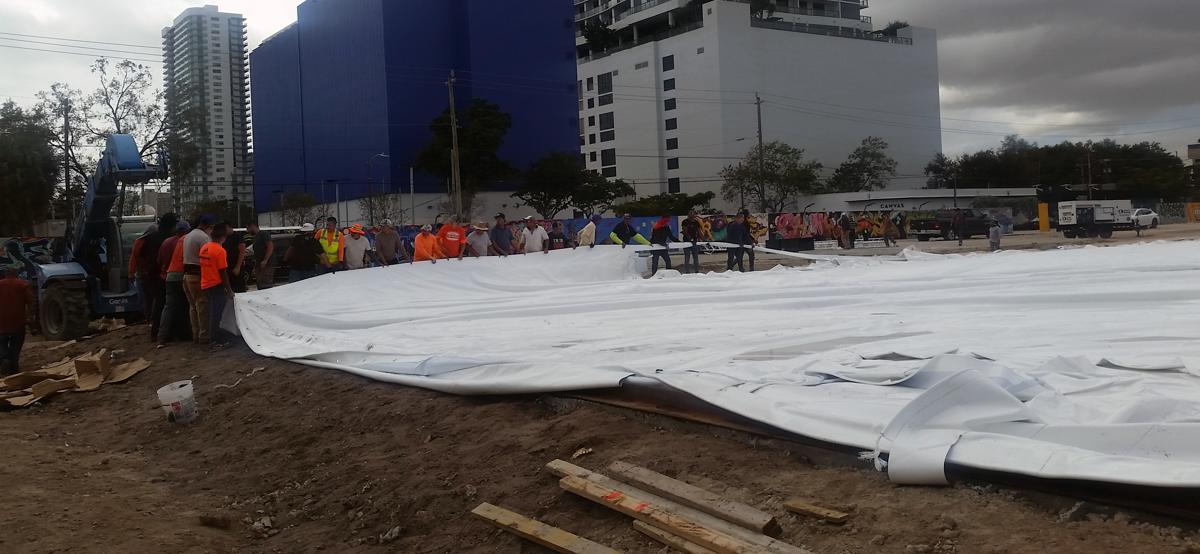
Step one: the crew unrolls the dome envelope on the prepared ground — Super Bowl LIV build, Miami, 2020.
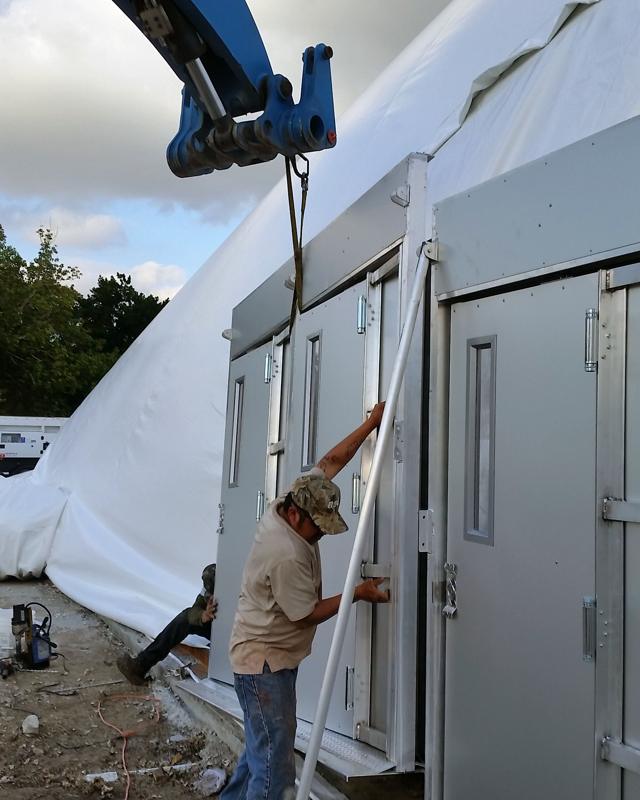
Step two: the two-door airlock entry system is fitted — every inflated Absolute Hollywood dome is entered through an airlock.
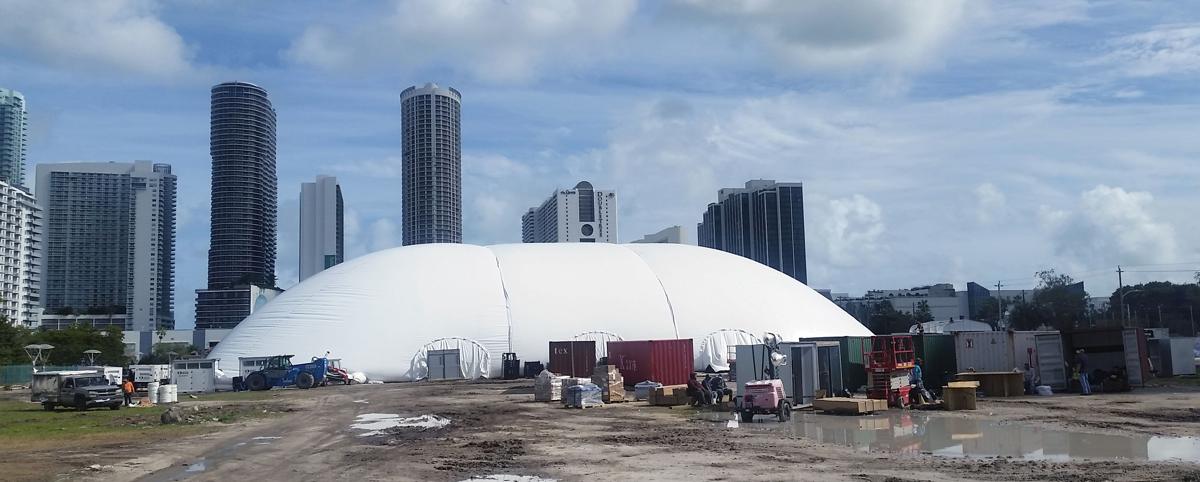
Step three: inflated and ready for the projection system — the Super Bowl LIV dome in Miami.
Above 90 ft the reasons compound: assembly stretches into weeks, freight volume grows past what is practical to ship, and crane requirements grow with it. An air-supported dome of the same span ships in a fraction of the volume, needs no crane, and a 235 ft (72 m) Celestial stands in four days.
| Factor | Geodesic | Inflatable Projection Dome |
| Maximum practical size | around 100 ft (30 m) practical ceiling — 160 ft is a major undertaking | From 235 ft (72 m) Celestial to 900+ ft (274 m) — roughly 200,000+ sq ft, no cranes at any size |
| Shipping weight | 1M+ lbs at 160 ft, 12 sea containers | Fraction of the weight — an air-shippable dome, deployable globally |
| Cranes required | Yes — above 60 ft | Crane-free dome installation at any size |
| Setup time | 3 to 4 weeks at event scale | 1–4 days dome only — projection system separate |
| Projection surface | Structural panels and seams visible | Seamless hemispherical membrane — uninterrupted fulldome image, built for projection mapping on fabric |
| Best for | Permanent structures under 60 ft where long-term rigidity is the priority | All events, touring, and installations of any size requiring fast setup |
Why Absolute Hollywood?
We Invented This. We Still Lead It.
Every projection dome company claims to be the best. Only one invented the industry. Absolute Hollywood has been designing, deploying, and operating domes since 1999 — 24 years before the Las Vegas Sphere opened in 2023 — every one delivered as turnkey experiential production, driven by the proprietary Sirius Media Server. That history is active, deployed, and available for your event today. For Galactic-series productions, explore dome rentals; for the biggest builds on earth, go straight to the 235-foot Celestial dome.
Absolute Hollywood designs, manufactures and operates its own domes. We are not a reseller fitting projection into a bought-in frame — we build the structures. The four cinespheres of Universal 360 at Universal Studios Florida were designed, built and installed by Absolute Hollywood, and ran for five years. Marvel’s touring attraction ran 4D motion car theater rides inside an Absolute Hollywood dome.
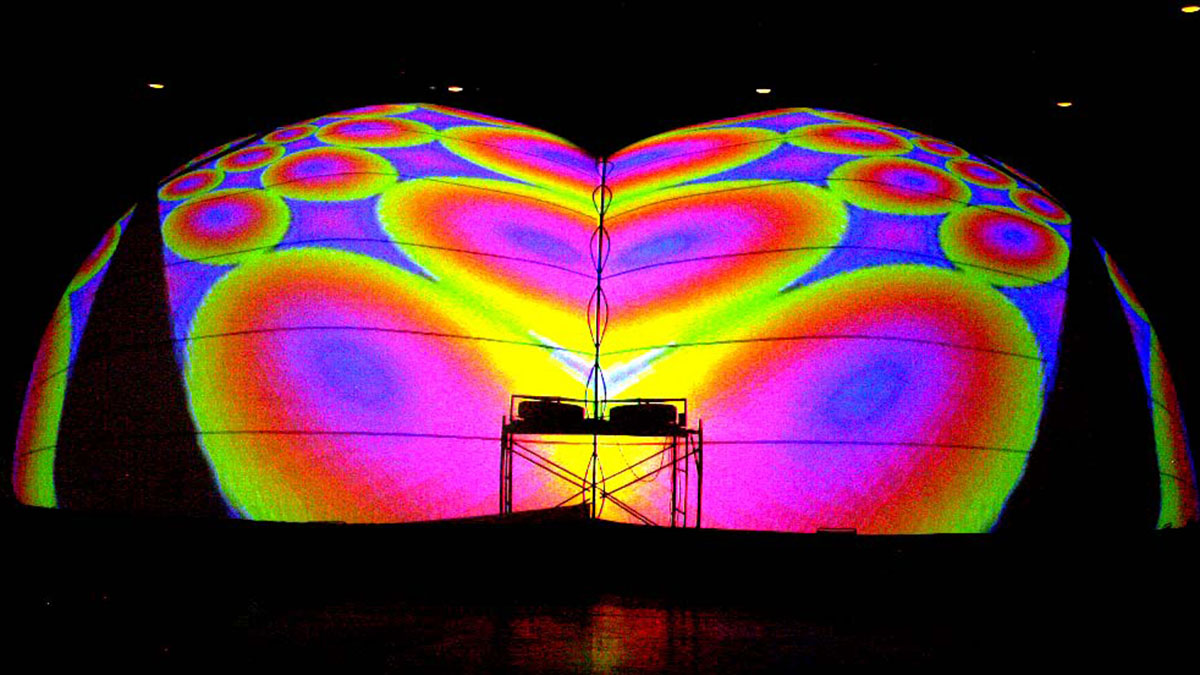
DoubleDome at the 2004 Stars Party, Orlando — two decades of dome innovation on the record.
|
1999 — Invented portable dome technology |
Government of Qatar, Bahrain, and UAE — national government ceremonies |
Ready to Build Something Unforgettable?
Plan Your Dome — Get a Quote
Tell us your event date, location, and vision. The world’s original projection dome company will make it happen — 360° inside and 360° outside, a full 720° of simultaneous projection, from 20 ft to 900+ ft (274 m), any country, any timeline.
Answered
What People Ask Before They Book
How much does it cost to rent a projection dome?
Absolute Hollywood quotes every dome as a turnkey build — structure, projection system, crew and engineering in one figure. Cost follows four things: which dome, from a fleet running 20 ft (6 m) to sizes up to 900+ ft (274 m) worldwide and counting; how many days on site; whether custom fulldome content is produced; and shipping distance to the venue.
Can I buy a projection dome, or only rent one?
Both. Absolute Hollywood rents domes for events and tours, and sells domes for permanent and semi-permanent installations, which its own crews install. The same fleet engineering covers both, from 20 ft (6 m) to sizes up to 900+ ft (274 m). A purchase is quoted on dome size, projection system, content and site work; a rental is quoted as a turnkey build.
What is a large projection dome?
A large projection dome is a portable projection dome roughly 65 feet in diameter or larger — big enough to hold an audience in the hundreds to several thousand. Absolute Hollywood’s large projection domes run from the 65 to 160+ ft Galactic series through the 235 ft Celestial, which holds 8,700 guests and is the largest available anywhere, and on up to 900+ ft (274 m) — roughly 200,000 sq ft of clear-span floor. They are air-supported rather than framed, ship on standard freight, and install in one to four days depending on diameter.
How big are inflatable projection domes?
Projection dome size is measured by floor area and capacity first. The 235 ft (72 m) Celestial encloses 43,373 sq ft and holds 8,700 people standing. The smallest Absolute Hollywood dome is 20 ft (6 m), and the fleet reaches sizes up to 900+ ft (274 m) worldwide and counting — roughly 200,000 sq ft (18,581 m²) of clear-span floor.
How long does it take to set up a projection dome?
Setup runs from the start of installation to the dome inflated and ready to enter. The StratoSphere sets up in 1 day; Galactic domes from 65 to 160+ feet take 1 to 3 days; the 235-foot Celestial stands in 4 days — dome only, with projection system installation scheduled separately. A comparable geodesic build takes 3 to 4 weeks. When schedules demand it, Absolute Hollywood can condense the timeline.
What happens to a projection dome in a storm?
Absolute Hollywood domes are engineered to meet or exceed the wind-load requirements of each deployment. In the field, AH domes have stood on snowpack at minus 20 degrees Fahrenheit in Vermont while snowing, through desert sandstorms with recorded winds of 83 knots, and through Arctic ice storms in 33+ countries since 1999. Interior air pressure is adjustable to counter rising external wind loads. Operational range: minus 40 to 140 degrees Fahrenheit. Weather-related event cancellations have not occurred.
What is the difference between an inflatable projection dome and a geodesic dome?
Both work below 90 feet; the difference is time. A geodesic dome is a rigid steel or aluminum frame assembled panel by panel. An Absolute Hollywood dome is air-supported — no frame, no crane, no triangular seams across the image. Above 90 feet geodesic assembly grows steeply harder and slower, while a 235 ft (72 m) Celestial still stands in 4 days.
What wind can a projection dome withstand?
The requirement is set by the jurisdiction, and Absolute Hollywood engineers to it. In the United States, temporary event structures fall under IBC/IFC Chapter 31 and are designed through IBC §1609 to ASCE 7, with duration provisions under ASCE 37 — which puts the design figure anywhere from roughly 90 mph inland to 175 mph in Miami-Dade, depending on regional wind speed, exposure and soil. Absolute Hollywood meets or exceeds the figure in force at each site, supplies structural documentation for permit, and engineers to tolerances above US requirements so the same domes certify internationally. Three interconnected Absolute Hollywood domes stood on a platform on Virginia Key, Florida through October and November — inside Atlantic hurricane season, in the highest design wind zone in the continental United States.
What is the difference between a projection dome and an LED dome?
Both wrap an audience in high-resolution 360° video, and both can be portable, permanent or semi-permanent. A dome — inflatable or geodesic — carries full-fulldome projection inside and can carry full-fulldome projection on its exterior as well, although exterior projection works only after dark. An LED dome emits its own light, but at the same size it costs far more to build or rent.
Can a projection dome be used as a planetarium?
Yes — and at a scale most planetarium suppliers do not work at. Absolute Hollywood builds large-format planetarium environments, including permanent fixed installations, rather than the small portable domes used for classroom outreach. Fulldome astronomy content plays exactly as intended, and the same structure also runs brand content, ride and simulator experiences with 4D motion seating, museum and science-center exhibits, and live performance.
Who invented the projection dome?
Absolute Hollywood invented portable inflatable projection dome technology in 1999 and made the first commercial deployment at the Sands Convention Center LDI Conference in Las Vegas in 2000, followed by MGM Grand and Luxor Las Vegas. The company still designs, manufactures, installs and operates its own domes — including the four cinespheres of Universal 360: A Cinesphere Spectacular at Universal Studios Florida, 2006 to 2011 — across 33+ countries.
Can a projection dome be used indoors?
Yes. Projection domes from 20 to 160 feet can be engineered for indoor deployment in convention centers, sports arenas, exhibition halls, and large indoor venues where ceiling clearance and footprint allow. The Absolute Hollywood team assesses indoor feasibility as part of every site survey — contact the team before ruling out any indoor configuration.
Can a projection dome be used for outdoor projection as well as inside?
Yes, and with Absolute Hollywood domes it is the norm rather than the exception. The dome is a projection surface on both faces: an immersive 360° environment inside, and outside the largest screen on the site — a curved, seamless, illuminated landmark. The two can run the same show, so the crowd outside sees what the audience inside sees, or two different shows at once, so a ticketed experience runs inside while the exterior carries a teaser, sponsor content or a separate public show. The exterior can also run for days ahead of the event as advertising for it. On the StratoSphere, both faces can be lit from a single projector package.
What is 360-degree dome projection?
360-degree fulldome projection is video projected across the entire inside of a dome, so the image surrounds the audience from the floor line to the apex with no edge. The video master is split across one or more projectors, warped to the dome’s curve and edge-blended into a single picture by a media server. Absolute Hollywood runs it on the proprietary Sirius Media Server.
How many projectors does a projection dome need?
It depends on the dome’s diameter and the brightness the show needs. A single very high-lumen projector through a fisheye lens can cover a dome up to about 50 ft, and above 30 ft Absolute Hollywood recommends a multi-projector, edge-blended array. The number of projectors grows with the dome, and every array runs from the Sirius Media Server so the image stays seamless.
What content plays inside a 360 projection dome?
Any video formatted for the dome, including live feeds. Content made for domes is called fulldome content: a circular fisheye frame, called a dome master, that maps onto the hemisphere. The Sirius Media Server also warps live camera and broadcast feeds onto the dome in real time. Absolute Hollywood’s 360 video production team produces new fulldome content and adapts existing brand, film and live material for every dome in the fleet.
Get a Quote
Tell us about your event and we will scope the right dome for it.
- Every size from 20 ft to 900+ ft (274 m)
- Engineered, installed and operated worldwide since 1999
- Fortune 500 launches, Olympic ceremonies, world tours, government events
- One call covers the dome, the projection and the crew
Prefer to talk it through? Call +1 443 341 6424.