
How Does 360-Degree Projection Work?
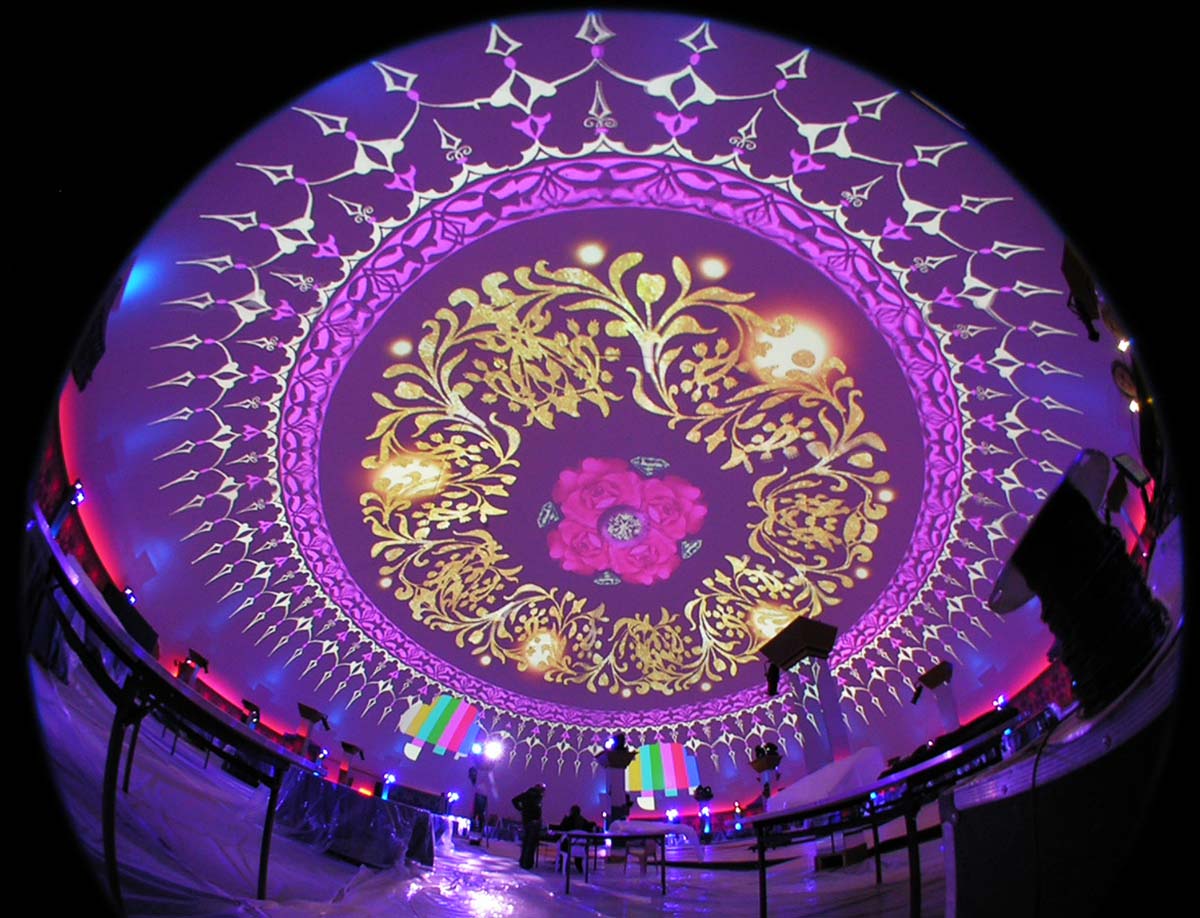
360-degree projection works by surrounding an audience inside a hemispherical or fully spherical dome surface and projecting seamlessly stitched video from a central media server onto every square foot of that surface simultaneously — above, beside, and in front of every viewer — creating complete visual immersion with no flat screen and no edge.
The inflatable projection dome serves as both the venue and the screen — multiple projectors map seamlessly across the hemispherical interior surface, wrapping every attendee in 360° of synchronized content.
Absolute Hollywood invented portable inflatable video projection dome and integrated dome technology to provide a fulldome immersive environment in 1999 and deployed the first commercial 360-degree projection dome in Las Vegas in 2000 — 23 years before MSG Sphere, or Vegas Sphere, opened. Every component of the system described below was developed, refined, and proven across deployments in 33 countries: the dome structure, the projection hardware, the media server, and the content pipeline. This is not theory. It is 26 years of operational engineering.
The Dome Structure: Engineering the Projection Surface
The projection surface is the foundation of the entire system. An inflatable projection dome creates a smooth, continuous hemispherical or spherical interior surface by pressurizing an air-sealed fabric shell — no frame, no rigging, no structural steel.
The Absolute Hollywood dome range spans 30 to 235 feet (9 to 72 meters) in diameter. At the large end, the Celestial Dome reaches 235 feet (72 meters) across, enclosing 43,373 square feet (4,030 m²) of floor space and accommodating 10,000 or more attendees. Its projection surface is 120 times larger than a standard IMAX screen. At the smaller end, the StratoSphere stands approximately 60 feet (19 meters) tall — a fully self-contained immersive dome that sets up in a single day.
Surface geometry matters enormously. A flat screen receives projected light at 90 degrees across its entire face. A hemispherical surface curves away from the projector at every point except the center. The dome surface material is therefore engineered with a gain curve — higher reflectivity at the edges where light arrives at shallower angles — to maintain consistent brightness from the zenith of the dome down to the screen base at floor level.
The structural integrity of an inflatable dome also solves problems that rigid geodesic structures cannot. A geodesic dome that exceeds 85 feet becomes increasingly problematic in setup and shipping, as the steel structure grows exponentially heavier per square foot of floor space. A geodesic dome at 160 feet (49 meters) requires more than 1 million pounds (450,000 kilograms) of steel, cranes for installation, and is restricted by wind load for screen cover installation. An Absolute Hollywood inflatable dome ships by land, sea, or air and has been proven operational in temperatures ranging from −40°F to 140°F (−40°C to 60°C) and through an 83-knot desert sandstorm. At all installation locations, domes are set up according to local environmental conditions and meet local code wind requirements.
How Does a Projection Dome Create a Seamless 360-Degree Image?
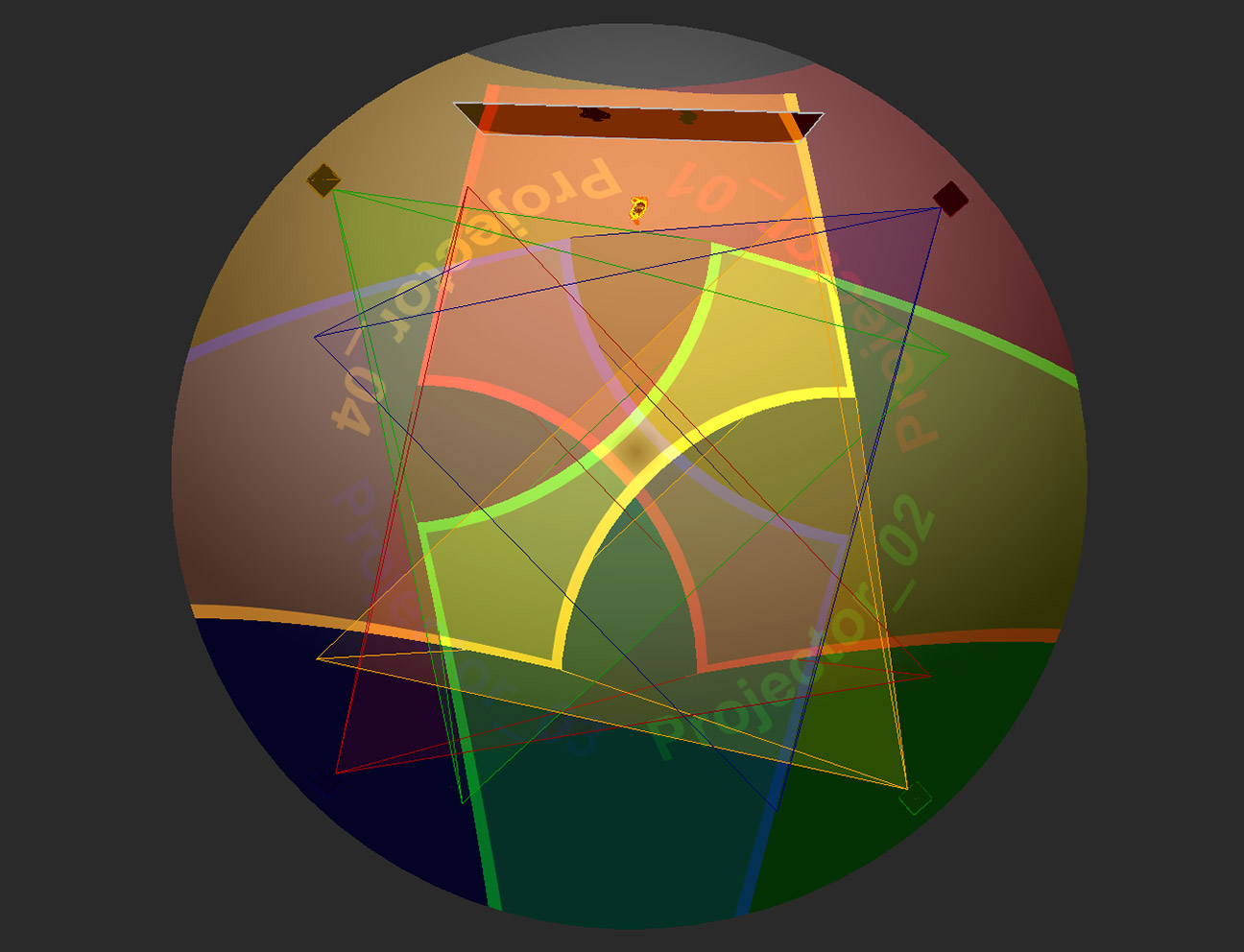
A 360-degree dome image is created by splitting a single video master into multiple synchronized projection channels, warping and blending each channel geometrically to match the dome’s curvature, then projecting all channels simultaneously so their edges overlap and the light output is blended in invisible transitions. The result is a single unbroken image covering the entire dome interior — no seams, no gaps, no visible projector cutoffs.
The process has three stages:
Stage 1 — Image splitting. A full-resolution video master is divided into sectors — typically four to eight in smaller domes, and well over forty in larger domes, depending on dome diameter and projector count. Each sector covers one region of the dome interior and is rendered in advance or in real time at the resolution required to fill that surface area at acceptable pixel density.
Stage 2 — Geometric warping. Each channel is mathematically warped before it leaves the projector. Because a flat projector lens throws a rectangular image and the dome surface is curved, every pixel must be repositioned to land in its geometrically correct location on the curved surface. This warping is calculated from the precise physical position of each projector relative to the dome center and the known curvature of the dome surface.
Stage 3 — Edge blending. Where two to four adjacent projection channels meet, their edges overlap by a calculated amount — typically 10 to 20 percent of frame width. Each channel is feathered at its overlap zone so that the combined brightness of the overlapping projectors equals the brightness of a single projector elsewhere on the surface. When correctly calibrated, the transition is invisible to the human eye from any viewing position inside the dome. In larger domes, projected images often overlap at four corners, above, below, and to each side of a given channel. At the very cap of a large dome, as many as eight projection channels may overlap at a single point — all of which must be blended to consistent brightness and color.
What Is a Full Dome Media Server and What Does It Do?
A full dome media server is the central processing unit that drives every projection channel simultaneously, maintains frame-perfect synchronization across all channels, and handles the geometric warping and edge blending calculations in real time. Without a dedicated full dome media server, a multi-projector dome system cannot maintain the synchronization required for a seamless image.
Absolute Hollywood operates the Sirius Full Dome 360-Degree Media Server — a proprietary system that plays any video source, any video format, at any resolution required by the dome configuration. Live broadcast feeds, pre-rendered animation, real-time game engine output, and interactive content all route through the same server without format conversion or quality loss. The Sirius system drives the entire Absolute Hollywood dome range from the Inflatable Projection Dome at 30 to 160+ feet (9 to 49+ meters) through to the 235-foot (72-meter) Celestial.
Media server synchronization is measured in milliseconds. If two projection channels feeding adjacent dome sectors are even slightly out of sync, moving content — a panning shot, a rotating logo, a tracking camera — will show a visible step or tear at the blend zone. Frame-locked synchronization ensures that all channels advance to the next frame at exactly the same moment, regardless of the total number of channels in the system.
The Sirius server also handles show control — triggering lighting cues, audio events, and interactive responses from a single interface. This unified control architecture is what allows a single operator to run a complete multi-projector, multi-channel immersive show from one position.
What Projectors Are Used in a 360-Degree Dome?
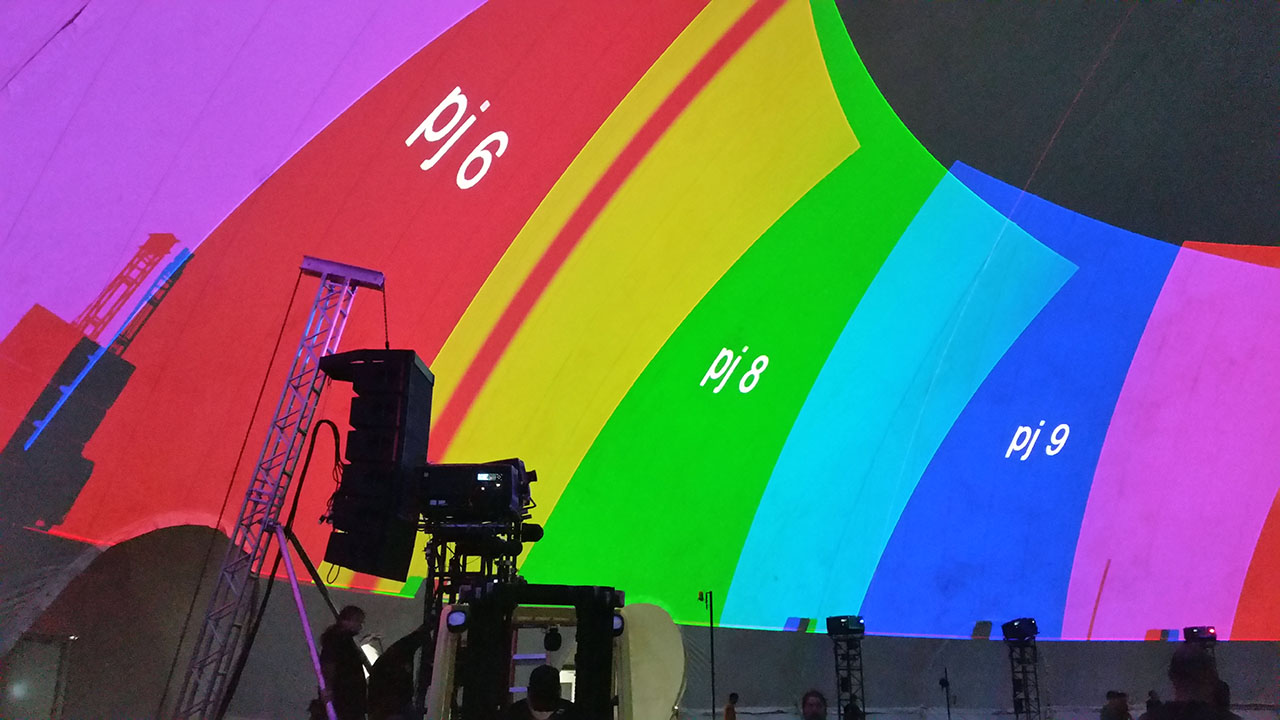
360-degree dome projection uses high-brightness digital projectors — typically laser phosphor or solid-state laser — positioned either at the center of the dome floor pointing upward (zenith projection) or distributed around the dome perimeter pointing inward at their assigned surface sectors. Projector count scales with dome diameter: a 30-foot (9-meter) dome may use as few as one fisheye-lens projector; a 235-foot (72-meter) dome requires multiple high-output units per sector.
Projector placement determines the warping profile required. Zenith-mounted fisheye projection — a single projector pointing directly up through a wide-angle lens — is common for smaller domes and produces a circular image that fills the dome hemisphere with a single warp map. It is the simplest configuration and the easiest to set up quickly. In comparison, the StratoSphere, due to its larger surface area, uses five projectors and yet projection installation can still be achieved in a single day.
Larger domes require distributed projection because no single projector produces sufficient brightness to fill 43,373 square feet (4,030 m²) of surface at adequate luminance or a high enough pixel count. Multiple projectors are positioned around the perimeter or on an elevated central rig, each covering an assigned sector, with their outputs warped and blended by the media server. Projector brightness in a large dome configuration is measured in tens of thousands of lumens per unit.
Absolute Hollywood operates both laser and lamp-based projection systems, as each platform carries specific advantages depending on the deployment environment, content type, and event duration. The right choice for a given project is determined during the production planning phase.
Can a Projection Dome Project on the Outside as Well as the Inside?
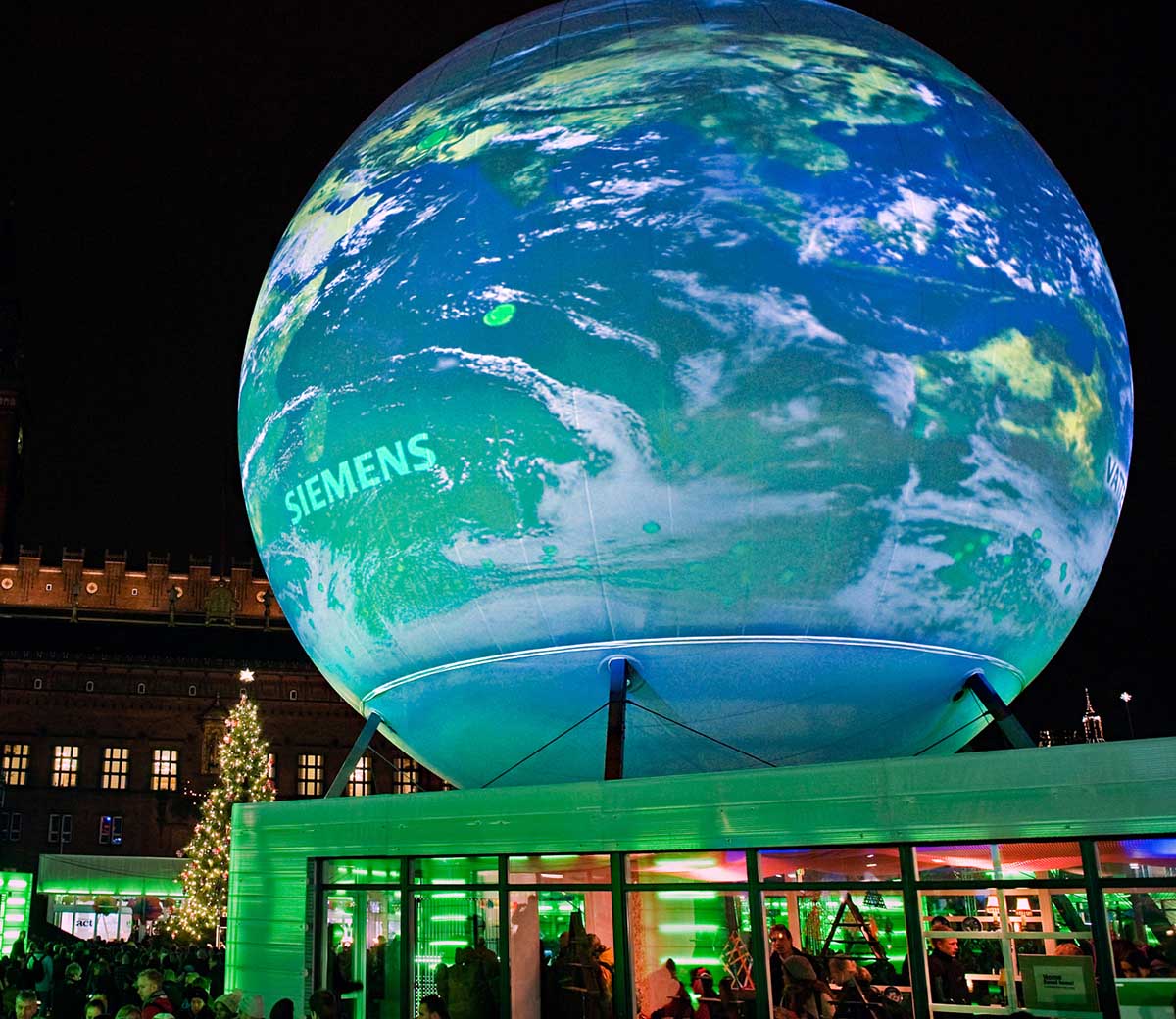
Yes. All Absolute Hollywood domes can be projected on simultaneously — on the interior hemispherical surface and on the exterior spherical surface — making the dome visible as an illuminated sphere while delivering a fully immersive interior experience to the audience inside. Interior and exterior projection operate from separate media server systems, which means the exterior can display entirely different content from the interior at the same time. A full show can run inside while the exterior displays a teaser reel, live projection, or other branded material for the surrounding crowd — ideal for outdoor concert projection with VIP interior access delivering exclusive content.
The exterior display operates as a large-format spherical canvas for branding, environmental content, event identification, and crowd-facing activation that extends the immersive event beyond the dome entrance.
The combination of interior experience and exterior spectacle is why Absolute Hollywood domes function both as contained event venues and as landmarks. At outdoor events and festivals, the illuminated exterior is the primary wayfinding signal and brand statement for the surrounding crowd — an audience that may be 50 or 100 times larger than the interior capacity.
What Kind of Content Plays Inside a Projection Dome?
A projection dome plays any video content that has been formatted for the dome’s aspect ratio and projection geometry — including real-time renders, pre-rendered fulldome animation, live broadcast feeds, interactive content, and branded environments. The Sirius Full Dome 360-Degree Media Server accepts any source format, which means content does not need to be native fulldome to enter the pipeline.
Content produced specifically for projection domes is called fulldome content. It is rendered to a circular fisheye frame — typically 4K or 8K resolution — that maps exactly onto the dome hemisphere when projected through a fisheye lens or warped through a multi-projector system. Absolute Hollywood’s 360 video production team produces and adapts content for every dome in the fleet.
Content categories that have run across Absolute Hollywood deployments include:
- Corporate brand environments — immersive product launch backdrops for Microsoft, IBM, Amazon, and Coca-Cola product activations
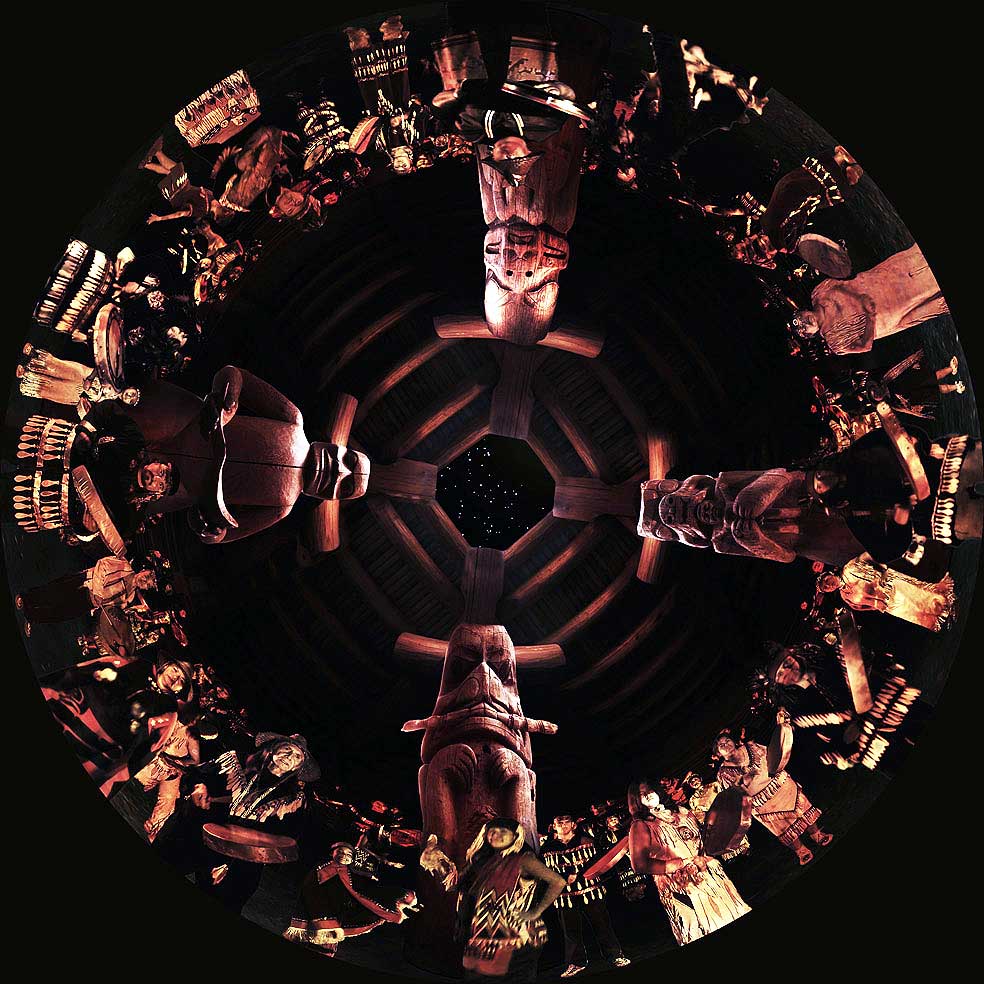
- Live entertainment — fulldome concert visuals, touring shows, and theatrical productions for Skrillex, Childish Gambino, Indigenous show productions at the Olympics, and more
- Sports activations — fan experience installations at Super Bowl LIV, NCAA Final Four, NASCAR, and the Vancouver 2010 Winter Olympics
- Scientific and educational programming — planetarium-style content, data visualization, and environmental presentations including the COP15 UN Climate Summit ceremony, the Year of Einstein in Berlin, and Space Week in Brussels
- Government ceremonies — the New Suez Canal Grand Opening, attended by heads of state, projected a custom show to thousands of guests inside an Absolute Hollywood dome
- Touring entertainment — The Marvel Experience (2014–2015) deployed seven interconnected Absolute Hollywood domes for a worldwide touring activation, with additional multi-content activations in Athens, Greece and Hong Kong
- Permanent installations — Universal Studios Florida ran an Absolute Hollywood dome from 2006 to 2011, serving millions of visitors annually
The practical implication for event planners is that content is not a constraint. If it exists as video, the Sirius server plays it. If it needs to be produced, Absolute Hollywood’s production team handles that from brief to final render.
How Long Does It Take to Set Up a 360-Degree Projection Dome?
Dome installation time ranges from one day for a 60-foot (19-meter) StratoSphere to four days for the largest 235-foot (72-meter) Celestial Dome configurations. These timelines cover structural dome installation — the dome erected and ready for interior load-in. Projection system installation, calibration, and technical rehearsal are scheduled separately and add time depending on the projector count and show complexity of the specific deployment.
To put that speed in context: a geodesic dome at 60 feet takes four or more days to install — the same size AH dome completes structural installation in one day. At 160 feet, a geodesic dome requires multiple weeks of on-site assembly with cranes and a large ground crew; an Absolute Hollywood dome of equivalent diameter installs in three days from ground level, without heavy lift equipment, and can arrive on-site in containers or crates that are air-freightable if the deployment timeline demands it.
The projection calibration phase — warp mapping and edge blending — is typically the most time-sensitive step after structural installation. Each projector’s warp profile must be solved for its exact physical position on that specific deployment site, because small variations in projector placement between deployments require the warp map to be recalculated. Absolute Hollywood’s crew carries pre-computed baseline profiles for each dome configuration that reduce on-site calibration time significantly compared to a cold start.
How Does 360-Degree Dome Projection Compare to a Cinema Screen or IMAX?
The Celestial Dome’s projection surface is 120 times larger than a standard IMAX screen. Compared to a premium digital IMAX auditorium — the IMAX at AMC Empire 25 in New York City, for example, features a screen measuring approximately 28 by 58 feet (8.5 by 18 meters) — the Celestial Dome is a continuous hemisphere 235 feet (72 meters) in diameter. The entire AMC Empire 25 IMAX screen would fit inside the Celestial’s projection surface many times over — and the dome wraps that surface around every viewer simultaneously, with no wall, no black border, and no seat that faces away from the image.
The experiential difference between a flat screen of any size and a hemispherical projection surface is not one of scale — it is one of architecture and immersion. A flat screen is always in front of you. A dome projection surface surrounds you. Peripheral vision — responsible for motion perception, spatial orientation, and presence — is engaged in a dome in a way that no flat screen activates regardless of how large it is.
The Vegas Sphere in Las Vegas, which opened in September 2023, operates on the same foundational principle as the Absolute Hollywood dome system deployed at the Sands Expo and Convention Center, now the Venetian Expo, for the LDI Conference in 2000. The underlying technology — hemispherical projection surface, multi-projector array, warped and blended channels, media server — is the same architecture, at different scales and with 23 years of additional development between them. A detailed comparison of the Vegas Sphere and the Absolute Hollywood system is available here.
Why Does Portable 360-Degree Projection Exist?
Portable projection dome technology exists because the overwhelming majority of events that benefit from immersive experience do not occur inside permanent facilities. A product launch in Dubai, a government ceremony in Egypt, a fan activation at a Super Bowl in Miami, a touring entertainment experience across three continents — none of these have access to a permanent dome. Portable projection dome technology brings the immersive experience to where the event is.
Absolute Hollywood founded the portable projection dome industry in 1999 specifically to solve this problem. The engineering challenge is not simply making a dome portable — it is making a complete, production-quality immersive experience portable: structure, projection, media server, content, and crew, all deployable on commercial transport infrastructure and operational on arrival, and backing that up with 26 years of dome experience.
The full Absolute Hollywood dome fleet spans 30 to 235 feet (9 to 72 meters) in diameter. For clients whose vision demands more, configurations scale to 100,000 square feet (9,290 m²), 200,000 square feet (18,580 m²), 300,000 square feet (27,870 m²), and beyond — there is no upper limit imposed by the technology. Deployments range from a single dome to multi-dome touring configurations and ship to any country by land, sea, or air. The same system that ran inside Universal Studios Florida for five years ran at the COP15 UN Climate Summit and the New Suez Canal Grand Opening. Portability does not compromise capability — it extends it.
Frequently Asked Questions
How many projectors does a 360-degree dome require?
Projector count scales with dome diameter. A 30-foot (9-meter) dome can operate with a single high-output fisheye projector. Domes in the 50 to 80-foot range typically use four to eight projectors. Domes in the 100 to 160-foot (30 to 49-meter) range require 12 to 42 projectors. The 235-foot (72-meter) Celestial Dome requires a multi-projector array beyond that range. All projectors run from the Sirius Full Dome 360-Degree Media Server, which maintains frame-locked synchronization across the full channel count.
What is the resolution of a 360-degree fulldome projection system?
Native fulldome content is typically produced at 2K, 4K, or 8K circular resolution, mapped to the dome hemisphere. Total delivered resolution scales with projector count — a multi-projector system aggregates the resolution of each channel across the surface, so a system with 12 or more projectors delivers substantially higher pixel density than a single-projector fisheye system on the same dome. The Sirius server accepts any input resolution and outputs at whatever native resolution the projector hardware requires.
Can a 360-degree projection dome operate outdoors?
Yes. Absolute Hollywood domes are designed for outdoor deployment and have operated in temperatures from −40°F to 140°F (−40°C to 60°C). All Absolute Hollywood installations are engineered and set up to meet the local temporary building code wind requirements for the installation location — coastal and high-exposure sites carry higher codes, and AH adjusts setup accordingly. Wind codes for AH deployments have typically fallen in the 90 to 120 MPH range, though AH meets whatever the applicable code requires. By contrast, many other inflatable dome companies are limited to 35 MPH wind ratings — below the threshold accepted for most corporate installations and likely to cause event cancellations in typical outdoor conditions. Contact Absolute Hollywood to discuss site-specific conditions for your event.
What is the difference between a fulldome show and a standard video projection?
Standard video projection throws a rectangular image onto a flat surface. A fulldome show renders a circular fisheye image specifically calculated to fill a hemispherical dome surface — wrapping the content around the audience rather than presenting it in front of them. The fulldome format engages peripheral vision, creates spatial depth, and produces a sense of physical presence that flat projection cannot replicate at any brightness or resolution level.
How does exterior projection work when projecting inside and outside simultaneously?
All Absolute Hollywood domes support simultaneous interior and exterior projection. The interior and exterior systems run from separate media servers, allowing entirely different content to play on each surface at the same time. A 60-foot (19-meter) StratoSphere projecting for 560 guests inside can simultaneously display different content to the crowd outside; the same architecture applies across the full dome range from 30 feet (9 meters) to 235 feet (72 meters). Interior content is warped to the hemispherical interior geometry; exterior content is mapped to the spherical outer surface. The result is a dome that serves as both an immersive venue for the interior audience and a visible landmark for the crowd outside.
Can live video feeds play inside a 360-degree projection dome?
Yes. The Sirius Full Dome 360-Degree Media Server accepts live broadcast feeds, camera inputs, and real-time data streams alongside pre-rendered content. Live feeds are warped and distributed across projection channels in real time, using the same geometric mapping applied to pre-rendered content. This capability has been used for live event coverage, sports activations, and interactive corporate presentations where real-time content and pre-produced immersive environments run simultaneously in the same dome.
Ready to Deploy 360-Degree Projection at Your Event?
Absolute Hollywood has deployed portable immersive dome systems at government ceremonies, Super Bowls, Olympic Games, Fortune 500 product launches, and touring entertainment activations across 33 countries. From a 60-foot (19-meter) StratoSphere that completes dome installation in a single day to a 235-foot (72-meter) Celestial Dome that transforms any venue into a 43,373-square-foot (4,030 m²) immersive environment — the complete system is available for your event.
Explore the full dome fleet, review the Celestial Dome and StratoSphere specifications, or contact the team to discuss your project.
Comments are closed.